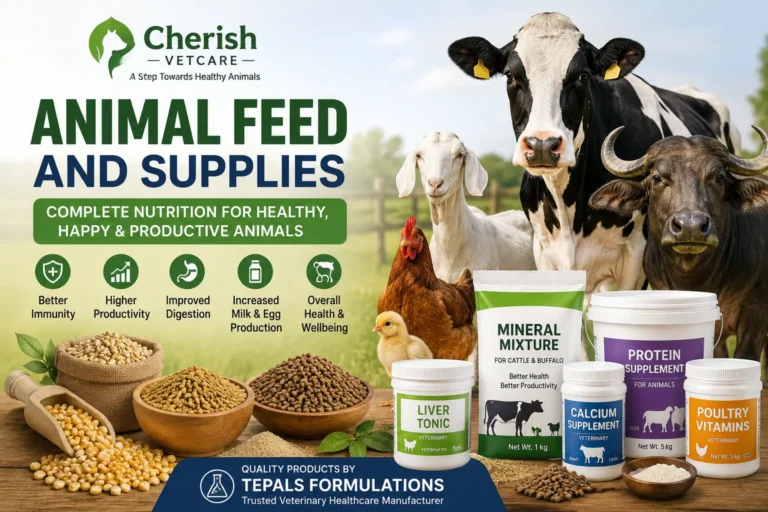
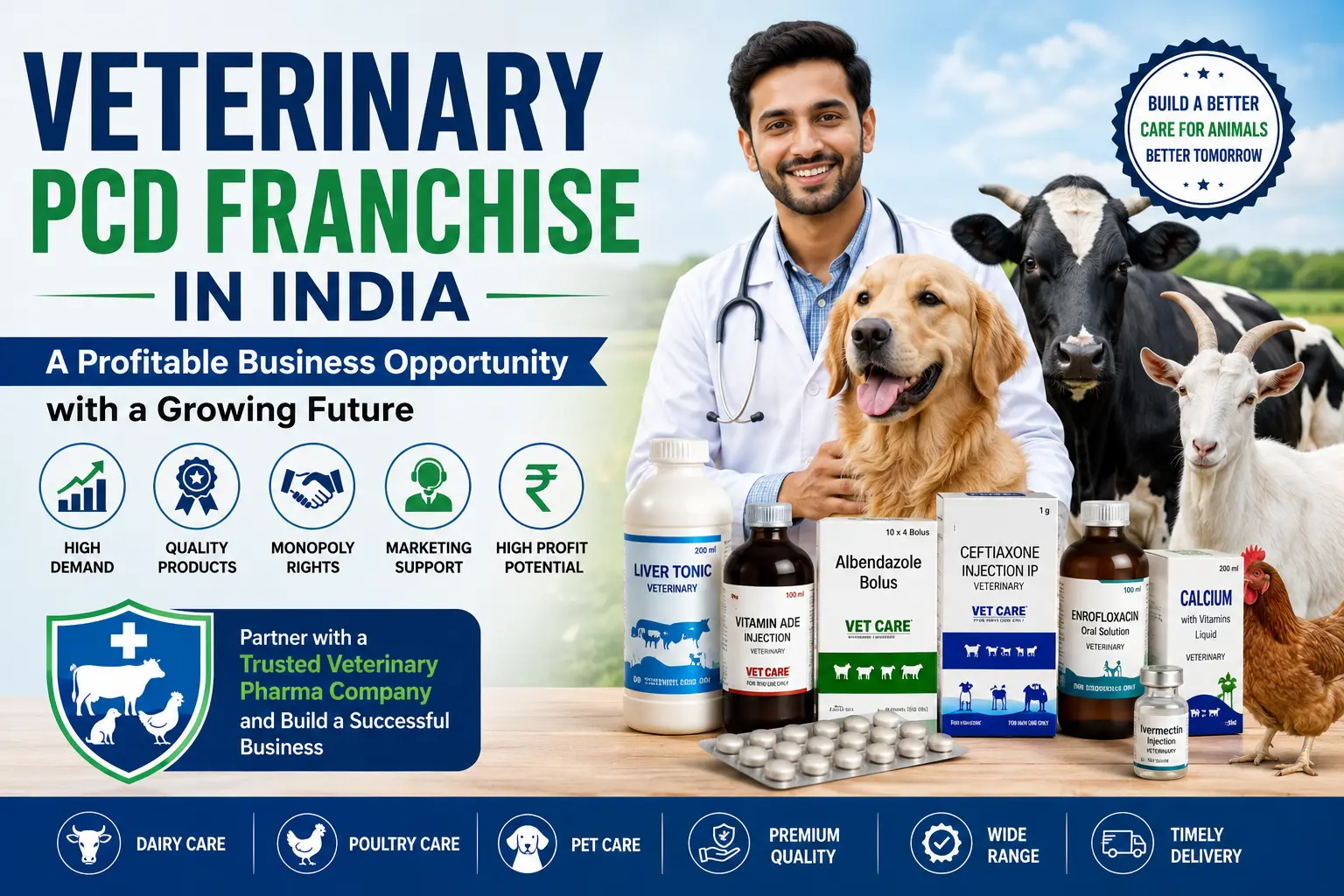
A Veterinary PCD Franchise in India offers entrepreneurs, veterinary professionals, pharmaceutical distributors, and animal healthcare suppliers the opportunity to market and distribute veterinary products within a defined territory. The franchise partner works with an established company, purchases products at an agreed commercial rate, and develops sales through veterinarians, veterinary pharmacies, dairy farms, poultry units, feed dealers, and livestock owners.
India offers a large operating base for animal healthcare businesses. According to the Department of Animal Husbandry and Dairying, the country produced 247.87 million tonnes of milk, 149.11 billion eggs and 10.50 million tonnes of meat during 2024–25. These figures do not guarantee franchise success, but they show the scale of India’s dairy, poultry and livestock economy.
The opportunity is attractive, but success depends on much more than obtaining a product list. For a veterinary franchise to be successful, there needs to be the right territory, the right mix of products, compliance with regulations, a reliable source of supply, good inventory planning and good relationships with local animal health providers.
What Is a Veterinary PCD Franchise?
A veterinary PCD franchise is a business arrangement in which an animal healthcare company authorises an independent partner to promote, sell and distribute its veterinary products within an agreed geographical area.
PCD commonly stands for Propaganda Cum Distribution. In practical terms, the franchise partner manages local promotion and distribution while the parent company provides products, brand material and commercial support.
Depending on the agreement, the franchise partner may receive:
- District-wise or area-wise monopoly rights.
- Veterinary product catalogues and price lists.
- Visual aids, product cards and promotional literature.
- Product images and digital creatives.
- Samples or reminder items.
- Product and sales training.
- Dispatch and inventory support.
- Assistance in selecting high-demand products.
A franchise agreement does not automatically create demand. It gives the partner a platform, product portfolio, and defined operating structure. Local execution determines whether the business grows.
Why the Veterinary Franchise Market Has Strong Potential
India’s animal healthcare market is supported by several connected sectors: dairy farming, poultry, commercial livestock, pet care, veterinary clinics, animal nutrition and disease-prevention programmes.
India ranked first globally in milk production in the government’s 2024–25 statistics. Uttar Pradesh, Rajasthan, Madhya Pradesh, Gujarat and Maharashtra together contributed 54.09% of national milk production. Andhra Pradesh, Tamil Nadu, Telangana, West Bengal and Karnataka were the five leading egg-producing states in the same period.
These numbers create multiple local demand clusters:
- Dairy belts need mineral mixtures, calcium supplements, fertility-support products, liver tonics, udder-care products and supportive nutrition.
- Poultry regions need nutritional products, sanitisation solutions, gut-health support and products appropriate to flock management.
- Pet-focused cities create demand for companion-animal medicines, grooming, nutrition and clinic-supplied products.
- Sheep, goat and mixed-livestock regions need species-relevant health and nutritional solutions.
- Veterinary hospitals and retail outlets need dependable, compliant product supply.
The Department of Animal Husbandry and Dairying also operates livestock health programmes focused on vaccination, disease surveillance, infrastructure and the control of economically important animal diseases. This highlights the continuing importance of organised animal healthcare systems across India.
How the Veterinary PCD Business Model Works
The typical business process is straightforward:
- The applicant selects a veterinary franchise company.
- The company checks territory availability.
- Both parties discuss products, rates, minimum order value, and commercial terms.
- The applicant provides business and regulatory documentation.
- The company issues a quotation or franchise proposal.
- The partner places an opening order.
- The company provides products and agreed promotional material.
- The franchise partner develops sales in the assigned market.
- Repeat orders are placed according to demand and inventory movement.
The partner usually earns through the difference between the purchase price and the selling price. Actual earnings depend on discount structure, retailer margins, promotional expenses, freight, credit losses, expiry, taxes, and monthly sales volume.
Veterinary PCD Franchise vs Distributorship vs Third-Party Manufacturing
| Business model | How it works | Best suited for | Main advantage |
|---|---|---|---|
| Veterinary PCD franchise | Products are marketed under the company’s existing brand | New and existing veterinary distributors | Faster market entry |
| Veterinary distributorship | Distributor supplies products to retailers and institutions, sometimes without monopoly | Established wholesalers | High-volume distribution |
| Private-label manufacturing | Products are manufactured under your own brand | Entrepreneurs building a long-term brand | Brand ownership |
| Third-party Veterinary manufacturing | A manufacturer produces products according to an agreed requirement | Marketing companies and product owners | Production without owning a factory |
A PCD franchise is generally easier for a beginner because the product names, packaging and brand identity are already established. Private-label manufacturing offers more control but requires additional work in branding, packaging, compliance, product positioning and market development.
Who is eligible to initiate a Veterinary PCD Franchise in India?
This business could be appropriate for:
- Distributors of veterinary medicine.
- Wholesalers of pharmaceuticals.
- Veterinary practitioners and animal health specialists, in accordance with relevant professional and commercial regulations.
- Suppliers of dairy products and cattle feed.
- Poultry product distributors.
- Animal feed supplement dealers.
- Medical representatives with veterinary-market experience.
- Entrepreneurs with strong rural or semi-urban networks.
- Existing PCD franchise owners expanding into veterinary products.
- Pet-care and veterinary retail businesses.
A veterinary degree is not automatically required to own every type of distribution business. However, the sale and distribution of regulated drugs may require appropriate licences, qualified supervision, compliant premises or other conditions. Requirements depend on the exact products and the rules applied by the relevant licensing authority.
Popular Product Categories in a Veterinary Franchise
A balanced product portfolio should reflect the dominant animals and farming activity in the territory.
Dairy and large-animal products
- Calcium and mineral supplements.
- Liver-support formulations.
- Digestive and rumen-support products.
- Energy supplements.
- Fertility and reproductive-support products.
- Udder-care products.
- Electrolytes.
- Feed supplements.
- Vitamins and trace-mineral products.
- Supportive products for lactation and recovery.
Veterinary pharmaceutical products
- Bolus formulations.
- Oral liquids.
- Powders and granules.
- Sprays.
- Ointments and topical applications.
- Injectables, where authorised and appropriately handled.
- Anthelmintic and antiparasitic products.
- Antibiotic or prescription products, where legally permitted.
- Anti-inflammatory and supportive medicines.
Poultry products
- Vitamins and minerals.
- Electrolytes.
- Gut-health products.
- Liver-support products.
- Feed additives.
- Sanitisation and biosecurity products.
- Stress-support products.
Companion-animal products
- Nutritional supplements.
- Skin and coat products.
- Deworming and parasite-control products.
- Digestive support.
- Joint and mobility support.
- Grooming and hygiene products.
- Veterinarian-recommended therapeutic products.
Do not select products only because the catalogue looks extensive. A smaller range of fast-moving, locally relevant products is usually easier to manage than a large opening inventory with slow movement.
Licences and Registrations Required
The required documentation depends on the nature of the products being sold. Veterinary medicines, biologicals, feed supplements, disinfectants and grooming products may not all fall under the same regulatory route.
1. Wholesale drug licence, where applicable
Under the Drugs Rules, licences in Form 20B cover wholesale sale or distribution of drugs other than those specified in Schedules C, C(1) and X. Form 21B applies to wholesale drugs specified in Schedules C and C(1), excluding Schedule X.
The rules also require adequate premises, proper storage and a person considered competent by the licensing authority for relevant sale and distribution licences.
This does not mean every veterinary franchise applicant automatically needs both forms. The correct licence depends on the products stocked and distributed. Before you begin operations, check the requirement with your State Drug Control Department or competent regulatory professional.
2. GST registration
GST registration may be required depending on the nature, turnover, location and structure of the business. It is also a frequent requirement of franchise companies for invoicing and business verification.
3. Business constitution documents
- The business may operate as a:
- Proprietorship.
- Partnership firm.
- Limited liability partnership.
- Private limited company.
- Other legally recognised entity.
The usual supporting documents are PAN, identity proof, address proof, partnership deed/incorporation documents
4. Premises documents
- You might need:
- Proof of ownership or a rental agreement.
- No objection certificate from owner.
- Design assumptions.
- Utility or electricity bill proof
- Storage Information.
Refrigerator or controlled-temperature facilities for products needing special storage.
5. Udyam registration
Eligible micro, small and medium enterprises can complete Udyam registration on the official government portal. The process is described by the Ministry of MSME as free and paperless.
6. Local registrations
Depending on the state and local authority, a shop and establishment registration, municipal trade permission or other local registration may apply.
7. Additional product-specific compliance
Veterinary vaccines and biological products require specialised regulatory and storage controls. CDSCO separately recognises veterinary vaccines within its biological-products framework.
Never assume that one registration covers every animal healthcare product. Obtain a written, product-wise compliance opinion where necessary.
Documents Commonly Requested by a Franchise Company
- Prepare a clear digital folder containing:
- Aadhaar or other accepted identity proof.
- PAN card.
- GST certificate where applicable.
- Wholesale drug license where applicable.
- Business registration documents.
- Address proof.
- Cancelled cheque or bank details.
- Passport-size photograph.
- Company letterhead.
- Signed franchise application.
- Territory requirement.
- Existing business profile.
- Expected opening order.
- Product categories of interest.
- Complete documentation reduces delays and makes commercial discussions more professional.
How Much Investment Is Required?
Investment varies according to the product range, territory, opening inventory, premises, licensing and credit policy. Some franchise marketing pages quote a starting range of approximately ₹1–5 lakh, but such figures should be treated as broad promotional estimates rather than a guaranteed setup cost.
| Cost area | Illustrative planning range |
|---|
| Business setup and professional assistance | ₹10,000–₹40,000 |
| Regulatory and local compliance | ₹10,000–₹75,000+ |
| Premises deposit, storage and basic setup | ₹25,000–₹1,50,000+ |
| Opening product inventory | ₹1,00,000–₹4,00,000+ |
| Printed and digital promotion | ₹20,000–₹80,000 |
| Delivery, travel and market development | ₹25,000–₹1,00,000 |
| Working-capital reserve | ₹1,00,000–₹3,00,000+ |
These are planning estimates, not official fees or a company quotation. A lean home-office-based distribution model may cost less, while a multi-district operation involving injectables, cold-chain products, staff and vehicles may require substantially more.
Working-capital formula
Use this simple calculation:
Working capital required = inventory value + customer credit outstanding + monthly operating costs − supplier credit
For example, a business holding ₹2 lakh in stock, offering ₹1.5 lakh in customer credit and spending ₹50,000 monthly would need more financial support than a business selling mostly against immediate payment
Profit Margin and Return on Investment
- There is no universal veterinary franchise margin. Commercial returns depend on:
- Product purchase rate.
- Retailer or dealer discount.
- Veterinarian and institutional terms.
- Freight.
- Promotional schemes.
- Sales incentives.
- Expiry and damaged-stock policy.
- Credit recovery.
- Product mix.
- Monthly order volume.
- Tax treatment.
- Simple margin calculation
- Assume:
- Your purchase cost: ₹600
- Freight and handling: ₹30
- Selling price to dealer: ₹800
- Sales and promotional allocation: ₹50
Contribution before overheads = ₹800 − ₹600 − ₹30 − ₹50 = ₹120
The ₹120 is not final profit. Rent, salaries, travel, bad debt, returns, and compliance costs must still be deducted.
Avoid companies promising fixed monthly income without reviewing your territory, sales capability and working capital. A real vendor will tell you how they get to the percentage, not just advertising a high percentage.
How to Start Veterinary PCD Franchise Business in India?
Step 1: Know your local animal population and market.
Is your locality populated with
- Dairy cows and buffaloes
- Chicken.
- Sheep and goats.
- Pig breeding
- Companion animals.
- Mixed livestock.
Visit veterinary hospitals, private clinics, dairy cooperatives, feed dealers and veterinary pharmacies. Note which product categories move regularly and which brands already dominate.
Step 2: Define your customer segments.
Your main customers may include:
- Veterinary doctors.
- Veterinary hospitals
- Veterinary Medicine Suppliers
- Owners of dairy farms.
- Poultry farms.
- Feed dealers.
- Livestock cooperatives.
- Animal-health distributors.
- Pet clinics and pet shops.
Each segment needs a different sales approach.
Step 3: Choose an appropriate territory
A district with high livestock activity may appear attractive, but competition, payment behaviour and distribution reach matter just as much.
Evaluate:
- Number of active veterinary clinics.
- Number of veterinary retail outlets.
- Density of Dairy and Poultry.
- Competition from current distributors
- Road connections.
- Freight charge.
- Customer credit cycle.
- Seasonal demand.
- Availability of monopoly rights.
Step 4: Shortlist veterinary PCD companies
- Compare at least three suppliers. Request:
- Product list.
- Price list.
- Product approvals or licences relevant to the range.
- Manufacturer details.
- Monopoly policy.
- Minimum order requirement.
- Terms of payment.
- Order dispatch.
- Promotional support.
- Expiry and breakage policy.
Step 5: Verify regulatory documents
Check the company’s legal name, GST details, manufacturing source, applicable licences, invoices and product labels.
Do not rely only on website badges such as “GMP,” “ISO” or “WHO-GMP.” Ask for current documentary evidence and verify that the document applies to the relevant company, manufacturing unit and product category.
Step 6: Finalise the product range
Start with products that solve frequent local needs. A practical opening range may contain:
- A few nutritional products.
- Fast-moving dairy supplements.
- Common digestive or liver-support products.
- Selected deworming or therapeutic products, where licensed.
- Hygiene or topical products.
- Region-specific poultry or companion-animal products.
Step 7: Review the franchise agreement.
The written agreement should specify the exact territory.
- Time for rights.
- Sales goals.
- Conditions for Maintaining a Monopoly.
- Payment terms.
- Responsibility for freight.
- Product-return policy.
- Settlement on expiry.
- Promotional Assistance.
- Brand Assets Use.
- Reason for termination.
- Dispute resolution process.
Step 8: Open a controlled order
Don’t buy all the products in the catalogue. Split the range into:
- A category: high-demand products.
- B category: moderate-demand products.
- C category: products supplied only against confirmed demand.
This protects working capital and cuts expiry.
Step 9: Begin systematic promotion
Prepare:
- Customer lists by product.
- Plan for daily visits.
- WhatsApp Catalog of Products.
- Digital Product Brief
- Introductory schemes
- Retailers order form.
- Veterinarian feedback form.
- Monthly follow-up calendar
Step 10. Track business performance
Review these numbers monthly:
- Sales by product.
- Gross contribution.
- Customer-wise outstanding payments.
- Inventory age.
- Expiry exposure.
- Repeat-order rate.
- New active accounts.
- Average order value.
- Sales return rate.
- Delivery cost per order.
Repeat sales and collections grow a franchise. The buying of new stock does not.
How to Choose the Best Veterinary PCD Franchise Company
Verify the product range
The company should offer products relevant to your market rather than only an impressive number of SKUs.
Check product quality and documentation
Ask for batch-related documents where appropriate, such as:
- Certificate of analysis.
- Manufacturing and expiry details.
- Product specifications.
- Applicable regulatory approvals.
- Manufacturer information.
- Storage instructions.
Evaluate stock availability
A franchise cannot retain customers if popular products are repeatedly unavailable. Ask the company about:
- Normal dispatch time.
- Back-order handling.
- Production lead time.
- Inventory updates.
- Seasonal stock planning.
Review packaging quality
Packaging should be:
- Easy to identify.
- Professionally printed.
- Resistant to normal transport conditions.
- Labelled with required statutory information.
- Suitable for the target customer.
Understand the monopoly policy
Ask whether the monopoly is based on:
- District.
- City.
- PIN code.
- Sales target.
- Product division.
- Customer segment.
A vague verbal promise is weaker than a written territory clause.
Compare commercial terms
Do not compare only the headline discount. Compare the effective landed cost after freight, schemes, taxes and promotional expenditure.
Examine expiry and damage support
Clarify:
- Minimum remaining shelf life at dispatch.
- Short-expiry notification policy.
- Replacement or credit-note terms.
- Leakage and transit-damage handling.
- Return authorisation process.
Test communication quality
Before placing a major order, observe how quickly the company provides documents, prices, availability and dispatch information. Slow communication before payment often becomes a larger problem afterward.
Why Consider Cherish Vetcare for a Veterinary Franchise?
Cherish Vetcare, a division of Tepals Formulations, is positioned to support entrepreneurs, distributors, and veterinary-market professionals seeking to build an animal healthcare business.
A suitable franchise partnership should provide more than products. It should help the partner choose a practical range, understand commercial terms, and maintain dependable product availability.
Potential partners can discuss:
- Territory availability.
- Veterinary product categories.
- Opening-order requirements.
- Promotional support.
- Packaging options.
- Distribution planning.
- Franchise and private-label opportunities.
- Product documentation.
- Dispatch and repeat-order support.
Before publishing company-specific statements about certifications, product counts, monopoly availability, or manufacturing capacity, add only information supported by current company documents.
Questions to Ask Before Paying a Franchise Company
- Is my required territory available?
- Will territory rights be given in writing?
- What is the minimum opening order?
- Is there a monthly or quarterly sales target?
- Who manufactures the products?
- Which licences apply to the products?
- What promotional material is included?
- Who pays freight?
- What is the normal dispatch time?
- What is the expiry-return policy?
- What remaining shelf life is provided?
- Are damaged products replaced?
- Can the company supply batch documents when required?
- Are prices protected for a defined period?
- What happens if the company appoints another distributor nearby?
Clear answers reduce misunderstandings later.
Frequently Asked Questions
1. What is a Veterinary PCD Franchise in India?
It is a business arrangement in which a veterinary healthcare company authorises a partner to promote and distribute its products in an agreed territory. The partner purchases products from the company and develops sales through local veterinary-market channels.
2. How much does a veterinary PCD franchise cost?
The investment depends on the product range, licences, premises, opening inventory and working capital. A small operation may begin with a controlled product range, while a multi-district business can require substantially higher capital.
3. Is a drug licence compulsory?
A drug licence may be compulsory when the business stocks, sells or distributes products regulated as drugs. The required licence depends on the product category. Feed supplements, biologicals, medicines and hygiene products should not automatically be treated as one regulatory category.
4. What are the monopoly rights in a veterinary franchise?
Generally, monopoly rights mean that the company undertakes not to appoint another franchise partner for the same range in the given territory, subject to the agreement and sales conditions.
5. Which veterinary products sell the most?
Demand varies by region. Dairy territories often require calcium, mineral, energy, liver and digestive-support products. Poultry regions may need nutrition, hygiene and flock-support products. Urban markets may favour companion-animal products.
6. Can a beginner start a veterinary franchise?
Yes, but beginners should first learn product categories, licensing, inventory management, local customer behaviour and credit control. Starting with a limited fast-moving range is generally safer than purchasing a large catalogue.
7. Which documents do I apply for?
Typically the documents needed are PAN, identity proof, address proof, GST registration (if applicable), business documents, bank details and the required wholesale drug licence (if applicable).
8. How much can a veterinary franchise make in profit?
Profit depends on landed cost, selling price, monthly sales, retailer margins, credit recovery, operating expenses and expiry. No responsible company can guarantee a fixed income without examining the territory and business model.
9. Is a Veterinary PCD franchise different from third-party manufacturing?
Yes. In a PCD franchise, you usually market the company’s existing brands. Third-party manufacturing is when a manufacturer makes products for your company, usually in your brand name.
10. How to choose a veterinary franchise?
Check product relevance, manufacturing sources, applicable licences, product documentation, stock availability, territory policy, expiry support, pricing, dispatch performance and communication quality.
11. Which territory is best for a veterinary franchise?
The best territory is one where you understand the animal population, customer network, competition, delivery route and payment behaviour. High livestock production alone does not guarantee commercial success.
12. How soon can I get started?
The timeline will depend on document readiness, licensing, company verification, territory approval and stock availability. Those with their documentation complete can usually move faster than those starting the regulatory process from scratch.
Conclusion
Starting a Veterinary PCD Franchise in India can be a practical route into the animal healthcare sector, especially for entrepreneurs with access to veterinary doctors, dairy farmers, feed dealers, poultry farms or veterinary retailers.
The strongest businesses do not depend only on monopoly rights or high discounts. They select products according to local demand, maintain regulatory compliance, protect working capital, monitor expiry and build dependable customer relationships.
Before investing, compare multiple companies, verify all important documents and calculate your landed cost, customer credit and monthly break-even point. A carefully planned territory with a focused product portfolio is more valuable than a large catalogue with weak market execution.