
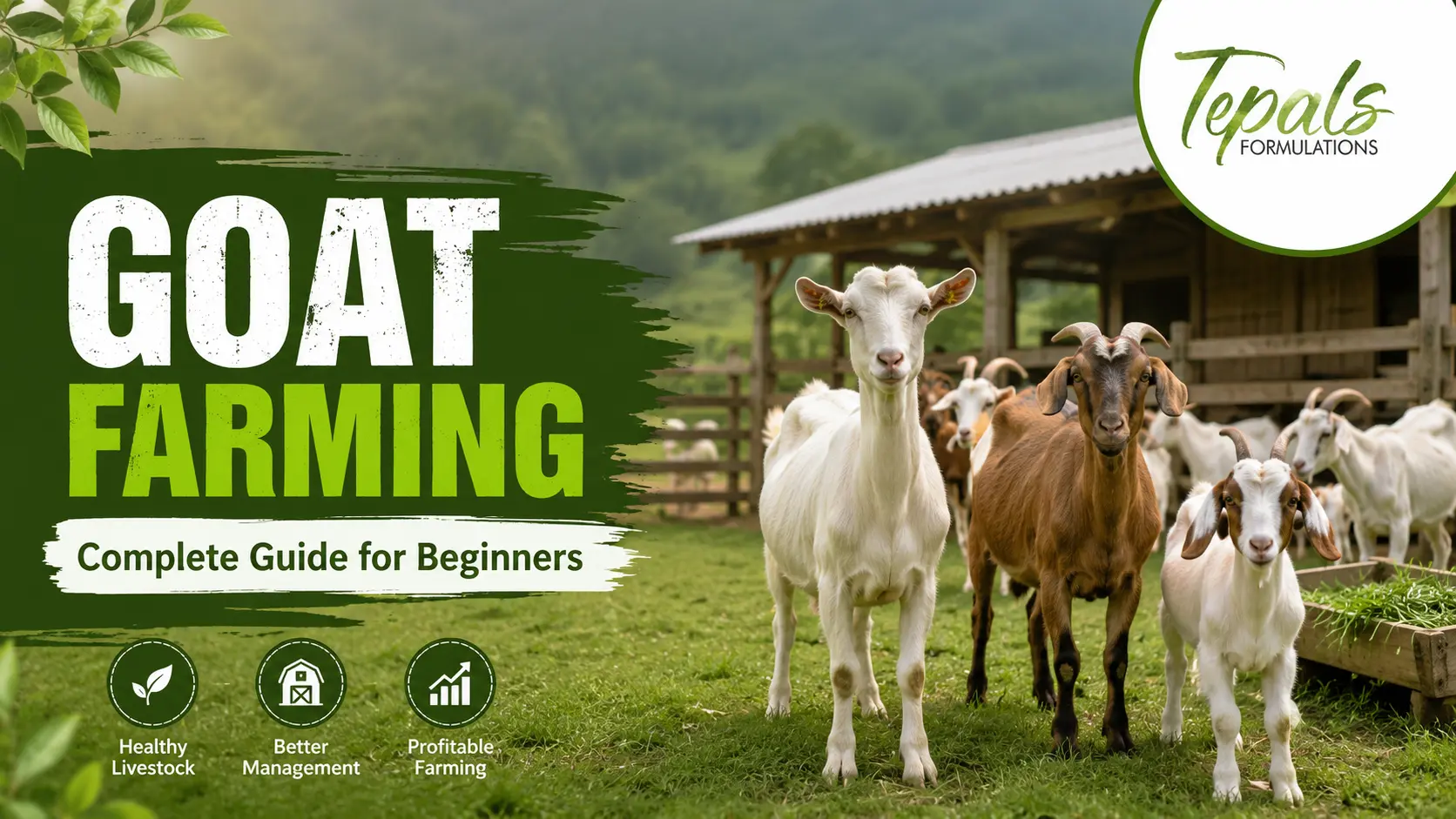
Goat farming is the practice of raising goats for meat, milk, breeding animals, manure, fibre, or a combination of these products. It can be started on a small family-owned scale or developed into a commercial livestock business.
India has a large goat population, strong domestic demand for goat meat, and a wide variety of locally adapted breeds. The Department of Animal Husbandry and Dairying’s goat-farming brochure cites a national goat population of 148.88 million, while ICAR notes growing interest in intensive and semi-intensive commercial goat production.
However, goat farming is not an automatic-profit business. The result depends on breed selection, feed cost, kid survival, disease prevention, local selling prices, and day-to-day management.
A profitable farm is usually built through careful planning rather than by buying the most expensive goats.
What Is Goat Farming?
Goat farming involves breeding, feeding, housing, and managing domestic goats for commercial or household purposes.
A goat farm may earn revenue from:
- Sale of goats for meat
- Sale of breeding males and females
- Goat milk and milk products
- Sale of young kids
- Goat manure
- Fibre and skin in specialised production systems
- Farm training or breeding services
In India, meat production is the most common commercial objective. Dairy-goat farming is possible, but it requires suitable breeds, milk-handling arrangements and a reliable market willing to purchase goat milk at a viable price.
Is Goat Farming Profitable in India?
Goat farming can be profitable if your animals are healthy, your kids survive, your feed is managed economically, and you can sell your goats through the right market.
ICAR identifies goats as important meat-producing animals with a strong domestic demand for chevon. It also mentions that commercial farms are increasingly using intensive and semi-intensive management systems.
Five major factors affect profit:
- Number of infants born alive and healthy
- Adult and child deaths
- Daily costs of feeding
- Growth rate and weight sold.
- Selling price and market access
The farmer who feeds his animals cheap feed and has good survival might make more money than a big farm that spends a lot of money on feed and loses animals to diseases that could have been prevented.
Simple goat-farming profit formula
Net profit = Total farm revenue − total operating expenses
Total revenue may include goat sales, breeding-stock sales, manure and milk.
Expenses generally include:
- Breeding animals
- Feed and fodder
- Labour
- Medicines and vaccination
- Electricity and water
- Transport
- Insurance
- Loan interest
- Shed maintenance
- Animal mortality
- Equipment depreciation
An ICAR publication comparing management conditions found that strategic feeding support substantially improved returns from Barbari goats in the study. This does not guarantee a fixed income, but it shows how strongly nutrition and management can influence farm economics.
Benefits of Goat Farming
Lower initial scale
Someone just getting started can start with a small number of animals rather than starting a big commercial farm.
Multiple sources of income
Goats can generate income through meat, breeding animals, manure, milk and young-stock sales.
Suitable for mixed farming
Goat rearing can be combined with crop farming. Crop residues may be used where nutritionally appropriate, while goat manure can support soil fertility.
Locally adapted breeds
India has many recognised indigenous goat breeds adapted to different climatic areas. The ICAR-NBAGR breed list currently includes 43 registered goat breeds, covering regions from Kerala and Tamil Nadu to Rajasthan, Punjab, Bihar, Jharkhand and the Himalayan states.
Regular market demand
Goats may be sold to meat traders, livestock markets, breeders, restaurants, individual consumers and other farmers. Demand can rise during festivals, weddings and regional events, although a business should not depend on one seasonal market alone.
Types of Goat-Farming Systems
Choosing the correct system affects land requirements, labour, feed cost and animal performance.
| Farming system | How it works | Suitable for |
|---|---|---|
| Extensive | Goats graze over a large area and receive limited supplementary feed | Areas with accessible grazing land |
| Semi-intensive | Goats graze for part of the day and receive feed inside the shed | Small and medium farms |
| Intensive | Goats remain mainly in sheds and receive cut fodder and concentrate | Commercial farms with limited grazing |
| Integrated | Goat production is combined with crops, dairy, poultry or fodder farming | Farmers seeking multiple income sources |
Large-scale goat farming
This approach can reduce purchased-feed costs, but uncontrolled grazing exposes animals to parasites, poisonous plants, accidents and inconsistent nutrition.
Semi-intensive goat farming
A semi-intensive system offers a practical balance for many Indian farmers. Animals receive exercise and natural browse while the farmer can control mineral, concentrate and dry-fodder supplementation.
Intensive goat farming
Intensive farming allows close monitoring and efficient breeding records. However, it creates high dependence on purchased or cultivated fodder. Poor ventilation, overcrowding, or irregular cleaning can quickly lead to health problems.
Best Goat Breeds for Farming in India
There is no single “best goat breed” for every state.
The right breed should match:
- Local climate
- Business purpose
- Feed availability
- Disease conditions
- Customer preference
- Availability of genuine breeding stock
- Veterinary support
The NBAGR list confirms the home tracts of many widely used breeds, including Barbari in Uttar Pradesh and Rajasthan, Beetal in Punjab, Black Bengal in West Bengal, Osmanabadi in Maharashtra, Jamunapari in Uttar Pradesh, and Sirohi in Rajasthan and Gujarat
| Breed | Common region | Typical business suitability |
|---|---|---|
| Black Bengal | West Bengal and eastern India | Meat, skin and small-farm production |
| Barbari | Uttar Pradesh and Rajasthan | Meat, breeding and semi-intensive farms |
| Sirohi | Rajasthan and Gujarat | Meat and commercial production |
| Osmanabadi | Maharashtra | Meat and adaptable farming systems |
| Beetal | Punjab | Meat and milk |
| Jamunapari | Uttar Pradesh | Milk, meat and breed improvement |
| Jakhrana | Rajasthan | Dairy-oriented production |
| Malabari | Kerala | Meat and milk |
| Marwari | Rajasthan | Dry-region production |
| Ganjam | Odisha | Regional meat production |
Local breed versus imported breed
Beginners are often attracted to large or imported goats because of their appearance and claimed growth potential. However, an animal that performs well on another farm may not perform equally well under your climate, feed supply, and disease conditions.
Start with healthy animals from a reliable regional source. A locally adapted breed with moderate performance may provide better results than an expensive breed that requires specialised care.
How to Start a Goat-Farming Business
1. Study the local market
Market research should come before animal purchase.
Speak with:
- Local meat traders
- Butchers and meat shops
- Livestock-market agents
- Restaurants
- Breeding farms
- Dairy-product businesses
- Farmers who purchase breeding goats
- Direct household buyers
Ask how goats are priced. Some buyers pay per animal, while organised sellers may negotiate according to live body weight.
Also identify the preferred breed, age, sex, body size and sale season.
2. Decide your business model
Choose whether your main revenue will come from:
- Meat animals
- Breeding stock
- Goat milk
- Festival-season goats
- Smallholder kid production
- Manure
- Mixed production
Avoid trying to serve every market during the first year. A clear model makes breed, feeding, and marketing decisions easier.
Depending on the capital, land, labour, and veterinary access available, a first-time farmer might want to start out with about 10 to 20 breeding females and one suitable male.
3. Begin small
Depending on the capital, land, labour, and veterinary access available, a first-time farmer might want to start out with about 10 to 20 breeding females and one suitable male.
Small beginnings buy time to understand
- Heat sensing
- Reproductions
- Pregnancy Care
- Feeding
- The kid: Signs of illness
- Feeding planning
- Record keeping Market price
“Expansion should be driven by sound management and not by loan availability.
4. Arrange training and veterinary support
Visit established farms before investing. Contact your local Krishi Vigyan Kendra, veterinary university, animal husbandry department or livestock-training institution.
ICAR case studies show that timely vaccination, deworming, feed management, mineral support and routine veterinary checks can reduce illness and mortality while improving growth.
5. Prepare a business plan
Your goat-farming business plan should include:
- Farm objective
- Number and type of animals
- Breed selection
- Shed cost
- Fodder availability
- Monthly feed requirement
- Labour cost
- Fodder availability
- Monthly feed requirement
- Labour cost
- Veterinary arrangement
- Expected kidding and mortality assumptions
- Marketing channels
- Emergency fund
- Loan-repayment schedule
Use conservative estimates. Do not calculate profit assuming every female produces twins, every kid survives, and every goat sells at a premium rate.
Design and Construction of a Goat House
The goat shed should protect the animals against rain, extreme heat, cold winds, dampness, and predators.
Features of a good Goat Shed
- Dry and well-drained location
- Adequate ventilation
- Protection from direct rain
- Sufficient natural light
- Non-slippery flooring
- Easy manure removal
- Clean feeding and water areas
- Separate pens for different groups
- Space for sick and newly purchased animals
- Safe fencing
Separate areas should be planned for:
- Breeding males
- Pregnant females
- Lactating females
- Young kids
- Grower goats
- Sick animals
- Newly purchased animals
Don’t overcrowd. It increases competition for feed, causes stress, and makes it easier for infections to spread.
Elevated shed vs ground shed
Wet areas: better drainage and manure management. Larger sheds. In dry areas, ground-level sheds can be more economical if the flooring and drainage are handled correctly.
The best structure depends on rainfall, soil type, local materials, and budget. A costly shed does not compensate for poor ventilation or weak daily cleaning.
Feeding and Nutrition Management
Feed is generally one of the highest recurring costs in commercial goat farming.
Goats require a balanced combination of:
- Green fodder
- Dry roughage
- Concentrate feed when needed
- Protein sources
- Mineral mixture
- Salt
- Clean drinking water
The exact quantity depends on age, body weight, pregnancy, lactation, growth stage, breed and grazing availability.
Green fodder
Common options may include suitable grasses, legumes and fodder-tree leaves available in the region. Farmers should confirm local fodder suitability because some plants may be harmful or unsuitable in large quantities.
Dry fodder
Dry fodder supports rumen function and becomes particularly important when green fodder is scarce.
Concentrate feed
Concentrate may be provided to growing kids, pregnant females, lactating goats, breeding males and animals being prepared for market.
More concentrate is not always better. Sudden feed changes or excessive grain can cause digestive problems.
Mineral supplementation
A mineral mixture formulated for small ruminants can support growth, reproduction and general nutrition when used according to professional guidance.
Water
Provide clean water throughout the day. Water containers should be positioned to reduce contamination by feed, manure and urine.
Illustrative Goat-Farming Cost for a Small Farm
The following table is a planning example for approximately 20 breeding females and one male. It is not an official quotation. Actual prices can vary significantly by state, breed, construction type, and animal quality.
| Expense | Illustrative planning range |
|---|---|
| Breeding animals | ₹1.60 lakh–₹3.20 lakh |
| Basic shed and fencing | ₹80,000–₹2.00 lakh |
| Feeders, drinkers and equipment | ₹15,000–₹40,000 |
| Initial feed and fodder reserve | ₹40,000–₹90,000 |
| Veterinary care, insurance and testing | ₹15,000–₹40,000 |
| Transport and miscellaneous expenses | ₹15,000–₹35,000 |
| Working-capital reserve | ₹40,000–₹1.00 lakh |
| Possible total excluding land | ₹3.65 lakh–₹8.05 lakh |
Do not copy this figure directly into a bank project report. Obtain quotations for animals, shed materials, feed, labour and transport from your district.
Keep enough working capital to operate the farm even if animal sales are delayed.
Goat-Farming Loan and Government Support
India’s National Livestock Mission includes entrepreneurship development, breed improvement, feed and fodder development, extension, livestock insurance and support for small-ruminant activities.
Current guidelines mention support and incentivisation for eligible individual entrepreneurs, FPOs, FCOs, joint liability groups, self-help groups and Section 8 companies. Scheme eligibility, project size, subsidy components and application procedures should be confirmed through the latest and the relevant state implementing agency
Before applying:
- Prepare a detailed project report
- Confirm land or lease documentation
- Collect quotations
- Check bank eligibility
- Identify a veterinary-support arrangement
- Study the latest scheme conditions
- Avoid agents promising guaranteed approval
- Confirm whether insurance is required
- Understand your own contribution and repayment liability
A subsidy should support a viable business. It should not be the only reason for starting one.
How to Market Goats Profitably
Many farms focus on production but start searching for buyers only when animals are ready.
Build market relationships from the beginning.
Possible sales channels
- Local livestock markets
- Meat traders
- Direct consumers
- Restaurants and caterers
- Breeding-stock buyers
- Farmer groups
- Digital livestock marketplaces
- WhatsApp and social-media enquiries
- Festival-season buyers
Where practical, sell according to live body weight instead of relying only on visual bargaining.
Keep photographs, weight records, breed details, vaccination history and parent information for breeding animals. Good records improve trust and help justify pricing.
Common Goat-Farming Mistakes
Buying animals without market research
A breed may be popular online but have weak demand in your district.
Starting with too many goats
A large herd magnifies feeding, labour and disease-management mistakes.
Purchasing from unknown traders
Animals may have hidden infections, incorrect age information or weak breeding history.
Ignoring quarantine
One infected animal can place the entire herd at risk.
Depending completely on purchased feed
Feed-price increases can quickly reduce margins. Develop a year-round fodder plan.
Building an expensive shed first
Invest in function, hygiene and ventilation rather than decoration.
Believing fixed-profit claims
Returns vary. Any promise of guaranteed monthly income should be treated cautiously.
Keeping no records
Without records, it becomes difficult to identify productive females, poor-performing males, repeat illnesses and actual profit.
Goat Farming FAQs
1. Can you make money from goat farming?
Yes, goat farming can be profitable if the feed costs, breeding, kid survival, health care, and marketing are managed well. Nothing for sure. Depends on the farm.
2. Which goat breed is best for farming?
The best breed depends on your climate, market, and purpose. Black Bengal, Barbari, Sirohi, Osmanabadi, Beetal and Jamunapari are widely known, but locally adapted animals are often safer for beginners.
3. How many goats should a beginner start with?
Many beginners may find a herd of 10 to 20 breeding females manageable. The correct number depends on land, labour, feed supply, experience and investment.
4. How much land is required for goat farming?
Land requirements depend on the farming system. Intensive farms need less grazing but need a reliable cut of fodder. More grazing is needed on large systems.
5. What do goats eat?
Goats consume green fodder, dry roughage, suitable leaves, concentrate feed when required, mineral mixture, salt, and clean water. The ration should be adjusted according to age and production stage.
6. Does a goat-farming loan exist?
Banks can finance viable livestock projects, and eligible applicants can be supported under government programmes like the National Livestock Mission. Conditions subject to official confirmation.
7. How can mortality be reduced?
Buy healthy animals, quarantine new goats, practice good hygiene, don’t overcrowd, feed a well-rounded diet, and have a vaccination and parasite-control program approved by your veterinarian.
8. Can goat farming be started without grazing land?
Yes. Goats can be maintained under an intensive stall-fed system, but the farmer must arrange a dependable and affordable year-round fodder supply.
9. Goat Farming: How to Make Money
In most of the farms in India, the sale of meat animals and young goats is the main source of income. Other sources of income are manure, milk and breeding stock.
10. How long does it take to earn profit?
The timeline varies according to the age of purchased animals, kidding cycle, mortality, growth rate and market. A farm should maintain working capital rather than depend on immediate sales.
Conclusion
Goat farming can provide a practical livestock-business opportunity for farmers and rural entrepreneurs, but success depends on more than buying good-looking animals.
Start with market research, locally suitable breeds, a functional shed, economical feeding and strong veterinary support. Pay special attention to quarantine, kid survival, record-keeping and buyer relationships.
A smaller, well-managed herd is usually a better starting point than a large farm built around unrealistic profit expectations.