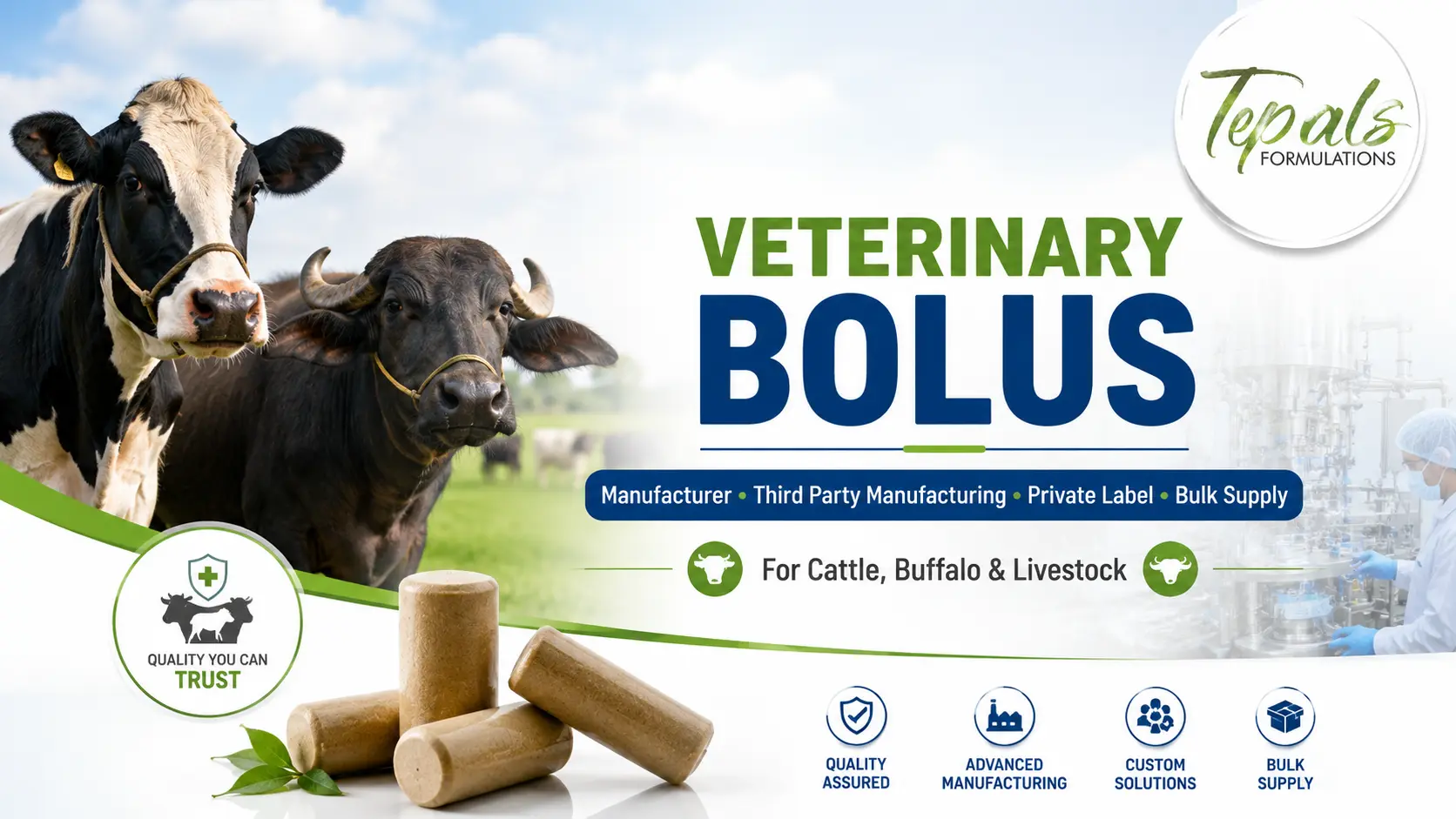
A veterinary bolus is a large solid oral dosage form developed for animals, particularly cattle, buffaloes, sheep and goats. Depending on its formulation, it may deliver a medicine, mineral, vitamin, probiotic, herbal ingredient or another animal-health component.
However, the word “bolus” describes a dosage form, not one particular treatment.
A calcium bolus, deworming bolus, antibiotic bolus and digestive-support bolus may look similar, but they have very different purposes, precautions and dosage instructions. Selecting a bolus only by its shape, color or popular name can lead to ineffective treatment and unnecessary risk.
This guide explains veterinary bolus uses, types, administration, safety and manufacturing in practical language for animal owners, distributors and private-label veterinary businesses.
Definition : A veterinary bolus is an oral preparation in the form of a relatively large tablet or capsule, which is intended to deliver a specific amount of medicine or nutritional ingredients to an animal. Some boluses break down after administration, while modified-release boluses designed to do so may remain in the digestive system and release ingredients over a longer period.
What Is a Veterinary Bolus?
A veterinary bolus is essentially a large oral tablet designed for an animal that may require a greater amount of active ingredient than can be conveniently provided in a small tablet.
It normally contains:
- One or more active ingredients
- Fillers or diluents
- Binding agents
- Disintegrating agents
- Lubricants
- Coating materials, where required
- Stabilising or release-controlling ingredients, where applicable
Boluses are often cylindrical, oval or capsule-shaped so they can be placed carefully at the back of the animal’s mouth with a suitable applicator.
The oral route is widely used in livestock. Veterinary oral products may include premixes, drinking-water additives, drenches, pastes, tablets, capsules and boluses.
Not Every Bolus Is a Long-Release Bolus
One of the most common online misconceptions is that every veterinary bolus settles in the rumen and releases ingredients for months.
That description applies only to certain intraruminal or modified-release products.
Other veterinary boluses are compressed oral tablets intended to break down and release their ingredients over a much shorter period. The actual action depends on:
- Product composition
- Formulation technology
- Coating
- Density
- Disintegration properties
- Target species
- Intended use
The label and technical product information should always be treated as the primary source of instructions.
Common Types of Veterinary Bolus
Veterinary boluses can be grouped according to their intended purpose. Product classification and legal requirements may vary based on ingredients, claims, and the applicable market.
| Bolus Category | Common Purpose | Important Consideration |
| Anthelmintic bolus | Control of specified internal parasites | Select according to parasite species, weight, and resistance risk |
| Antibiotic bolus | Treatment of susceptible bacterial infections | Use only with veterinary oversight and follow the complete course |
| Anti-inflammatory bolus | Support in managing pain, fever or inflammation | Avoid combining medicines without professional advice |
| Calcium bolus | Oral calcium support, commonly around calving | The animal must be able to swallow safely |
| Mineral and vitamin bolus | Correction or prevention of a defined nutritional gap | Avoid unnecessary duplication with feed and supplements |
| Digestive bolus | Rumen, digestion or appetite support | Identify the underlying reason for reduced feed intake |
| Probiotic or enzyme bolus | Digestive and microbial support | Product performance depends on strain, enzyme activity and stability |
| Reproductive-support bolus | Nutritional or veterinary support around reproductive management | Infertility needs diagnosis rather than random supplementation |
| Herbal bolus | Composition-specific supportive use | “Herbal” does not automatically mean risk-free |
| Modified-release rumen bolus | Gradual delivery over a defined period | Must be suitable for the animal’s age, weight and rumen development |
1. Deworming and Anthelmintic Bolus
Anthelmintic boluses are formulated to control specific internal parasites. Depending on the active ingredient, a product may target roundworms, lungworms, flukes or other parasites.
A deworming programme should not be based only on a fixed calendar or repeated use of the same molecule. Parasite type, local conditions, animal age, grazing pattern and treatment history all matter.
Resistance has been documented across important anthelmintic classes, and repeated exposure to the same drug class can select resistant parasites.
A practical parasite-control programme may consider:
- Veterinary diagnosis
- Faecal testing where practical
- Targeted treatment
- Correct body-weight estimation
- Proper dose
- Pasture management
- Treatment records
- Monitoring the response to treatment
The MSD Veterinary Manual recommends that cattle parasite treatment decisions consider the target parasite burden, susceptibility and expected benefit rather than relying on indiscriminate treatment.
2. Antibiotic Veterinary Bolus
An antibiotic bolus may be prescribed for a bacterial infection when the selected medicine is appropriate for the suspected or confirmed organism.
Antibiotics do not treat every case of fever, diarrhoea, respiratory distress or reduced appetite. These signs may result from viruses, parasites, metabolic disorders, poisoning, feeding problems or other causes.
Inappropriate antibiotic use increases the risk of antimicrobial resistance. WOAH identifies excessive or unsuitable antimicrobial use as a factor in the emergence of resistant organisms.
For safe use of antibiotics: Seek advice from a vet.
- Use the correct medicine for the diagnosis.
- Follow the prescribed dose and treatment duration.
- Do not stop simply because the animal appears better.
- Record the animal, product, batch and treatment date.
- Follow the stated milk and meat withdrawal instructions.
Antibiotic boluses should not be marketed as routine growth promoters or universal remedies for healthy animals. WHO recommends restricting medically important antibiotics for growth promotion and disease prevention without diagnosis.
3. Calcium Bolus for Cattle
Calcium boluses are commonly discussed in relation to dairy cows around calving and the risk of hypocalcaemia.
They should not be given blindly to every cow. The stage of the condition, the animal’s ability to swallow, the calcium source and the herd’s nutritional programme need consideration.
University of Minnesota Extension warns that an oral calcium bolus should not be given to a cow that remains down and cannot swallow properly because of the risk of choking.
The MSD Veterinary Manual also describes oral calcium boluses as a preferred oral supplementation form in appropriate standing cows, while noting that product formulation and calcium salt solubility influence performance.
This is a useful real-world example of why “one bolus for every animal” is unsafe advice. The animal’s clinical condition matters as much as the product.
4. Mineral and Vitamin Bolus
Mineral boluses may contain calcium, phosphorus, zinc, copper, cobalt, selenium, or other nutrients. Multivitamin boluses may include fat-soluble or water-soluble vitamins.
They may be useful when:
- A deficiency has been identified
- Feed quality is inconsistent
- The ration lacks a specific nutrient
- Animals have higher requirements during a production stage
- A veterinarian or animal nutritionist recommends supplementation
More is not always better. Minerals and fat-soluble vitamins can cause problems when given in excessive or duplicated quantities.
Before using a mineral bolus, review:
- Current feed formulation
- Mineral mixture already being supplied
- Water mineral content
- Other injections or supplements
- Animal age and production stage
- Regional deficiency patterns
5. Digestive, Probiotic and Appetite-Support Bolus
Digestive boluses may contain probiotics, yeast, enzymes, buffers, herbal ingredients or nutritional compounds.
They are commonly positioned for:
- Reduced appetite
- Dietary transition
- Digestive stress
- Rumen support
- Recovery after illness
- Changes in feed intake
A digestive bolus should not delay the examination of an animal with severe bloat, persistent diarrhoea, recurrent abdominal pain, complete loss of appetite, poisoning, foreign-body disease, or another emergency.
Supportive products may assist recovery, but they cannot replace diagnosis when the underlying condition is serious.
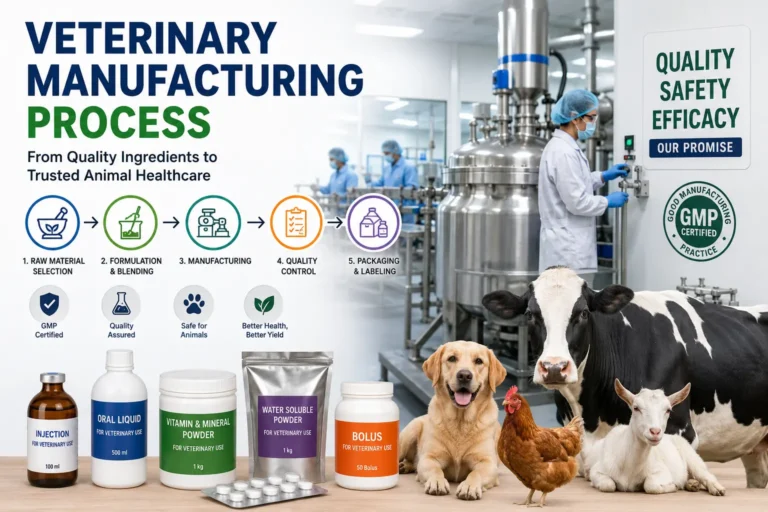
Veterinary Bolus Manufacturing Process
Veterinary bolus production requires more than compressing powder into a large tablet.
A typical project includes the following stages.
1. Review of Product Requirement
The manufacturer considers:
- Target animal species
- Product category
- suggested composition
- Active ingredient potency
- Claims designed
- Immediate or sustained release
- Pack size required
- Focus on market
- Regulatory status classification
- Order quantity expected
2. Development of Formulation
The formulation team selects active ingredients and suitable excipients.
The bolus should have enough mechanical strength to survive handling and packaging while still releasing its ingredients according to the intended design.
Tepals Formulations’ manufacturing guidance specifically notes that a bolus needs suitable hardness and proper disintegration behaviour.
3. Raw-Material Verification
Incoming materials should be checked against approved specifications before use.
Things to consider include:
- Identity.
- Assay or strength
- Purity, 1887.
- Dampness
- Properties of particles
- Microbial quality as appropriate
- Documentation from supplier
- Conditions of storage
4. Mixing & Mastering
The ingredients are weighed according to the approved manufacturing records.
Uniform blending is critical because each bolus must contain a uniform amount of the desired ingredients.
5. Direct compression or Granulation
Depending on the formulation, the blend may be granulated before compression or may be suitable for direct compression.
The chosen process should deliver:
- Good flowability of powder
- Uniform filling of the
- Suitable hardness
- Low breakages
- Proper disintegration or release
6. Compression
The mixture is pressed to the desired size and shape of the bolus.
In compression, we follow:
- Average weight
- Uniform weights
- Thickness:
- Roughness
- Defects such as capping or cracking
7. Coating if needed
A coating can be used for:
- Moisture Guard
- Easier management
- Taste masking
- Less irritation
- Product recognition
- Extended-release
The coating must be compatible with the formulation and the desired release profile.
8. Quality Evaluation
The exact quality tests depend on whether the bolus is a pharmaceutical medicine, feed supplement, herbal product, or another regulated category.
Private-label buyers should ask the manufacturer which specifications apply to the proposed product and request the relevant batch documentation.
9. Labelling and Packaging
Common bolus package includes:
- Blister packs
- Strip packs
- Alu-alu bag
- Sachets
- Jars or bottles
- Printing boxes
The packaging must protect the bolus from moisture, breakage, contamination, and mix-ups.
10. Batch Release and Dispatch
Finished goods should be released only after the required production records, quality results, and packaging checks have been reviewed.
Selecting a Veterinary Bolus Manufacturer in India
A distributor should not select a manufacturer only because the quotation is cheaper.
Evaluate the manufacturer on:
- Product-category capability
- Manufacturing approvals
- Formulation experience
- Quality-control systems
- Batch documentation
- Packaging options
- Artwork review
- Minimum order quantity
- Commercial transparency
- Production timeline
- Complaint handling
- Batch traceability
- Dispatch consistency
- Support for repeat orders
Documents a Buyer May Request
Depending on the product and transaction, buyers may ask for:
- Manufacturing licence details
- Applicable product approval
- GST and company documents
- Product specification
- Certificate of Analysis
- Sample label or artwork
- Batch details
- Stability or shelf-life support
- Packaging specification
- Commercial quotation
- Manufacturing agreement
Claims such as “ISO-GMP,” “ISO certified,” should be verified against the exact manufacturing unit and product category rather than accepted only from marketing material.
Third-Party Veterinary Bolus Manufacturing
Third-party manufacturing enables a veterinary marketing company, distributor, or startup to sell boluses under its own brand without building a complete manufacturing facility.
The general process is:
- Share the intended product or composition.
- Confirm the regulatory category and technical feasibility.
- Select the bolus size, pack and quantity.
- Review the commercial quotation and MOQ.
- Approve the product or sample specification.
- Create regulatory-compliant label artwork.
- Upload all files.
- Buy a bunch and see for yourself
- Pack the bolus you finished.
- Release and dispatch the order.
Information to Share for a Quotation
Provide:
- Proposed product name
- Composition and strength
- Target animal
- Intended purpose
- Pack size
- Number of boluses per strip or box
- Expected quantity
- Preferred packaging material
- Brand name
- Target state or market
- Required delivery timeline
- Whether the formula is standard or customised
Tepals Formulations for Veterinary Bolus Manufacturing
Tepals Formulations provides veterinary manufacturing support for businesses seeking boluses and other animal-health product formats.
Its official website describes services such as:
- Veterinary product manufacturing
- Private-label manufacturing
- Custom formulation development
- Bulk production
- Packaging and labelling support
- Documentation assistance
The company’s published manufacturing information covers boluses, liquids, powders and feed-supplement formats, with final availability depending on formulation feasibility, product classification and regulatory requirements.
Tepals Formulations is based in Ambala, Haryana, and lists veterinary third party manufacturing enquiries through its official contact page.
Potential enquirers include:
- Veterinary medicine distributors
- PCD franchise companies
- Animal-health marketing companies
- Dairy product dealers
- Livestock wholesalers
- Veterinary professionals
- Private label startups
Frequently Asked Questions
1. What is a veterinary bolus?
A veterinary bolus is a large solid oral dosage form developed to deliver a measured quantity of medicine, minerals, vitamins or other ingredients to an animal. It is commonly used for cattle, buffaloes, sheep and goats.
2. What is a veterinary bolus used for?
Its use depends on the composition. Veterinary boluses may be developed for parasite control, bacterial infections, pain and inflammation, calcium support, mineral supplementation, digestive support or other defined veterinary purposes.
3. Is every veterinary bolus slow release?
No. Some boluses are conventional large tablets that disintegrate after administration. Others are specially formulated modified-release or intraruminal boluses that release ingredients over a longer period.
4. How is a bolus given to cattle?
The bolus is usually given orally by means of a properly sized bolus applicator or balling gun. The procedure should be done by a veterinarian or a trained animal handler, and the animal should be properly restrained.
5. Can a bolus be given to a cow that is lying down?
A bolus should not be forced into an animal that cannot swallow safely. In particular, a severely weak or recumbent cow may choke. Obtain immediate veterinary guidance.
6. Can I crush a veterinary bolus and mix it with feed?
Do not crush, split or dissolve a bolus unless the label or veterinarian specifically allows it. Altering the product may affect its dose, coating, stability or release pattern.
7. Is a veterinary bolus the same as a tablet?
Both are solid oral dosage forms, but a bolus is generally larger and designed to deliver a greater quantity to livestock or other large animals. The term may also be used for modified-release intraruminal products.
8. Can I prescribe veterinary boluses?
The requirements depend on the active ingredients, classification of the product and local legislation. Antibiotic, antiparasitic, anti-inflammatory and other medicinal boluses should be used under appropriate veterinary guidance.
9. What is the withdrawal period of a veterinary bolus?
There is no single withdrawal period for every bolus. It depends on the active ingredient, dose, formulation, species and approved label. Follow the exact milk and meat withdrawal instructions printed on the product or provided by the veterinarian.
10. What should distributors check before buying veterinary boluses?
Check the manufacturer’s approvals, complete composition, specifications, packaging, batch documentation, minimum order quantity, label compliance, product classification, quality system and complaint-handling process.
11. Does Tepals Formulations provide private-label veterinary bolus manufacturing?
Tepals Formulations describes veterinary manufacturing, private labelling, custom formulation, bulk veterinary manufacturing, and packaging support among its services. Final bolus availability depends on composition, feasibility, and applicable regulatory requirements.
Conclusion
A veterinary bolus can provide a practical way to administer medicines or nutritional ingredients to cattle and other livestock, but the dosage form should never be confused with a universal treatment.
The correct product depends on the animal, diagnosis, body weight, composition, release design and intended purpose. Safe administration, accurate records, responsible antimicrobial use and proper withdrawal-period compliance are essential for protecting animal health and food safety.
For distributors and private-label brands, the manufacturer should be assessed on technical capability, documentation, quality controls, packaging, traceability and commercial reliability—not price alone.