India’s vitamin C tablet market is rapidly expanding. Many companies now provide vitamin C products to increase immunity or boost wellness. These products are offered by pharmaceutical companies, nutraceutical startups, and wellness distributors.
Even with the increasing competition in the vitamin C market, businesses still have to create unique products to find success. For example, businesses have to ensure they create a quality product by choosing an experienced manufacturer, researching formulation development, testing quality, and understanding the regulatory aspects of vitamin products.
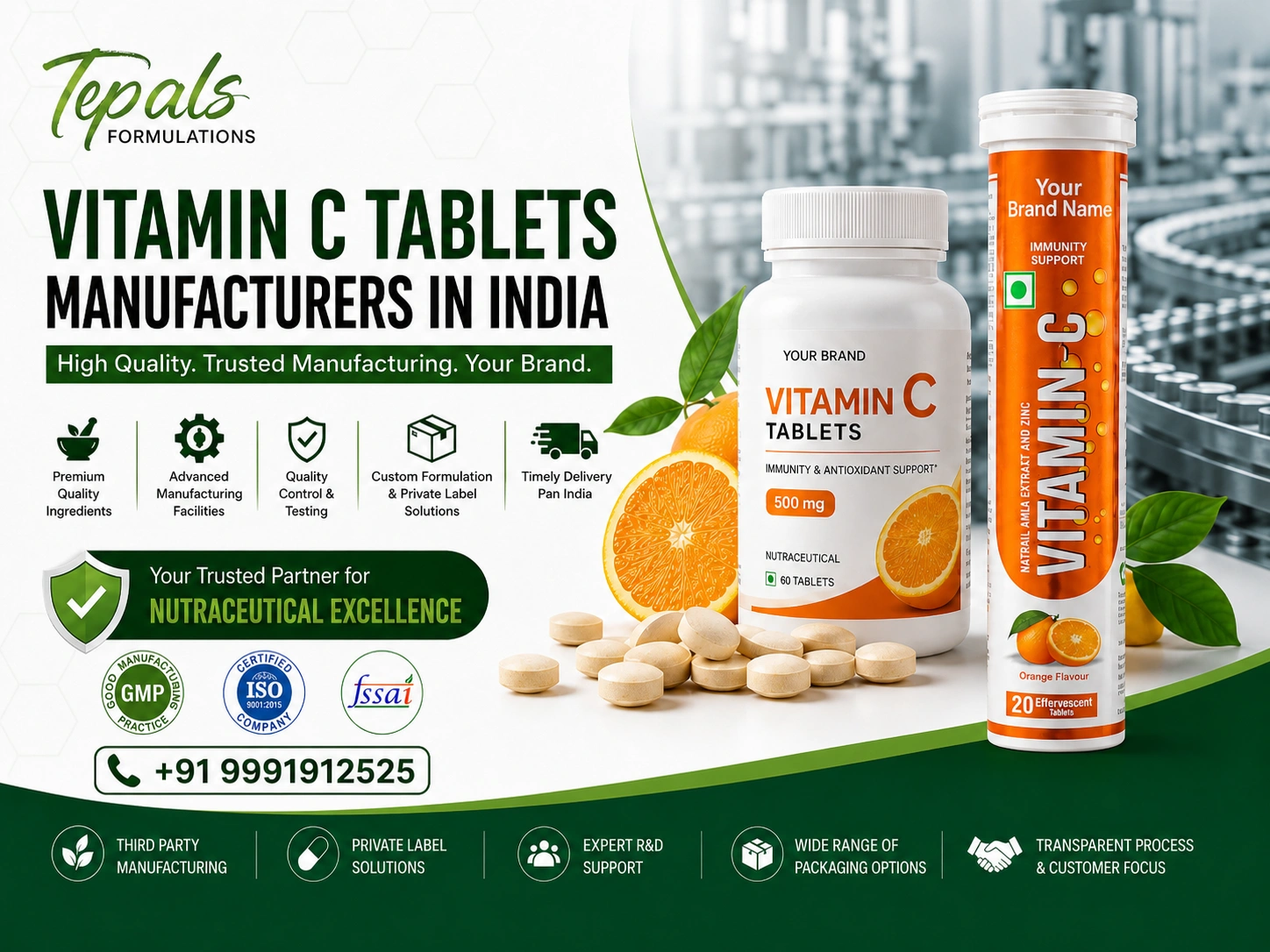
Tepals Formulations provides private labeling and third party Nutraceutical manufacturing for businesses wanting to create their own vitamin C tablets.
Who is Making Vitamin C Tablets?
Only appropriately funded pharmaceutical and nutraceutical companies with well-established regulatory permissions and a quality control system can manufacture vitamin C tablets.
The following services are offered by Tepals Formulations:
- Third-party manufacturing of vitamin C tablets
- Private-label manufacturing of supplements
- Development of compositions
- Manufacturing and packaging of tablets
- Support for labeling and branding
- Manufacturing in bulk
- Support for regulatory documentation
- Assistance with logistics across India
Custom formulations and related packaging, along with the associated claims and regulatory requirements, must be completed to start manufacturing.
What Factors Contribute to the Increasing Market Demand for Vitamin C Tablets in India?
Attributable to the higher consumer confidence in the Indian market regarding preventive healthcare and ways to improve one’s nutrition, immunity, and skin, in addition to leading a more active lifestyle, Vitamin C tablet consumption has grown.
Additionally, Vitamin C products are becoming a priority in the market for the following reasons:
1. Increased Knowledge of Everyday Nutrition
Increased knowledge of everyday nutrition has spread to the consciousness of more consumers. Because of the added simplicity of Vitamin C products, it is easier for brands to communicate the value and relevance of the Vitamin C product.
2. Increased Demand for Nutraceuticals
The Indian nutraceuticals market encompasses a wide variety of supplement formats, such as tablets, powders, gummies, and effervescent products.
Vitamin C needs no formulation and can be marketed as a product.
3. Greater Accessibility of Online Supplement Providers
Vitamin C products have become even more accessible with the added presence of direct-to-consumer brands, online pharmacies, wellness and healthcare-focused startups, and fitness-based service providers.
4. Ease of Use
The ease of use and transport of tablets is an added convenience.
5. Greater Demand for Antioxidants and Immunity Products
Causation and correlation claims regarding Vitamin C and its assistance with normal immune function will need to be more carefully and responsibly communicated, as no product can claim to cure a disease.
Options for Manufacturing Vitamin C Tablets
A competent manufacturer of Vitamin C tablets may have varying levels of product development options.
Standard Vitamin C Tablets
Offer a fixed amount of Vitamin C in a standard tablet. A cost-friendly supplement option for those brands with basic product requirements.
Chewable Vitamin C Tablets
These are tablets that can be consumed without the need for swallowing. They are fondly developed with fruit flavors and friendly sweetening systems.
While product development may want to take a stab at the many areas of product development such as consideration of flavor, mouthfeel, tablet hardness, stability of the flavor, and aftertaste; this should be a last resort.
Effervescent Vitamin C Tablets
Effervescent tablets dissolve in water and are consumed. This product format is popular as a convenient, refreshing, and responsive improvement over other product options.
Effervescent tablets take on a unique formulation and require moisture-proof processing and special packaging.
Vitamin C Combination Tablets
Vitamin C can be combined with other vitamins, minerals, natural extracts and/or antioxidants. However, this is contingent on the product regulations of the concerned product category.
Some of the potential product offerings may be:
- Vitamin C and Zinc
- Vitamin C and Vitamin D
- Vitamin C and Citrus Bioflavonoids
- Vitamin C and Amla Extract
- Vitamin C and Rosehip Extract
- Multivitamin Tablets
- Antioxidant Support Formulations
All of these combinations would need to be validated for compatibility of the ingredients, safety, stability, as well as the manufacturing regulations.
Sugar-Free Vitamin C Tablets
These are options without sugar for brands that want to target a population that is more concerned with their health and calories. Additionally, the sweetening system and product claim need to be compliant with the applicable standards.
What Does Manufacturing Vitamin C Tablets Involve?
The specifics of manufacturing Vitamin C tablets can vary depending on their types, compositions, packaging materials, and the tools used. However, any process would incorporate the stages listed below.
Stage 1: Needs Assessment
The manufacturer first identifies the following details:
- How much Vitamin C should be in the tablets?
- How should the tablets be designed?
- Who is the target consumer?
- Which flavor should the tablets be?
- Which type of packaging should the tablets be in?
- How many tablets should be made?
- How much should the tablets be sold for?
- How should the brand be positioned?
- Which other ingredients should be in the tablets?
- What should the label for the tablets claim?
This stage allows the manufacturer to determine whether a custom composition is needed.
Stage 2: Designing the Composition
The relevant active ingredient is added to a composition of excipients, and the balance of the following factors is considered:
- Size of the tablet
- Taste of the tablet
- How quickly the tablet breaks apart
- How hard the tablet is
- How stable the tablet is
- How sensitive the tablet is to moisture
- What the law allows
- How the tablet will be sold
Step 3: Sourcing the Ingredients
The needed ingredients for the tablets should be purchased from approved suppliers. Ingredients should be assessed based on quality standards.
Assessment of the ingredient quality can include:
- Do the supplier documents support the quality claims?
- What is the identity of the ingredient?
- What is the purity of the ingredient?
- What is the moisture content of the ingredient?
- What does the ingredient appear to be?
- What is the microbial limit of the ingredient?
- What is the assay for the ingredient?
In manufacturing, consistency is the quality of the product that is most important.
Step 4: Blending/Granulating
The ingredients for the tablets are weighed and blended per the approved formulation.
Depending on the characteristics of the ingredients, some of the blending techniques that can be employed are compression, granulation, and/or dry or wet granulation.
Step 5: Compression
The formulated ingredients for the tablets are compressed using tablet-compression equipment.
During tablet manufacture, the production team assesses the following properties:
- The weight of tablets
- The weight variability of the tablets
- The thickness of the tablets
- The hardness of the tablets
- The appearance of the tablets
- The tablets friability
- How quickly the tablets disintegrate.
These checks help maintain consistency throughout the batch.
Step 6: Coating, Where Required
To enhance aesthetics, ease of swallowing, taste, and the protection of Vitamin C tablets from the environment, some Vitamin C tablets are film-coated. There are also other forms of Vitamin C dosage forms, such as tablets with chewable and effervescent properties. These forms have specific processing requirements that may be different from film-coated tablets.
Step 7: Quality Testing
Before any commercial distribution, the final dosage forms are evaluated to ensure compliance with the specifications of the approved product. Different forms, features, and regulatory classifications of tablets may warrant different quality control evaluations. These evaluations may include tests for the following:
- Appearance
- Average weight
- Assay
- Disintegration
- Friability
- Microbial quality
- Stability
- Integrity of the packaging
Step 8: Packaging and Labeling
Post quality assessment approval, packaging is done. The packaging format may be any of the following:
- Blister strips
- Alu-alu packs
- HDPE bottles
- PET bottles
- Plastic jars
- Effervescent tubes
- Printed cartons
- Bulk containers
The labeling must have all the requisite information for that specific product classification.
Vital Role of Packaging for Vitamin C Tablets
Environmental conditions such as heat, moisture, air, and light may damage Vitamin C. Proper packaging is, therefore, very essential to maintain the quality of the product within the declared shelf life.
The Manufacturer must help the Brand with the following considerations when selecting the packaging:
- Protecting from Moisture
- Protecting from Light
- Tablet Format
- Protecting Packaging during Transport
- Market Positioning
- Convenience for the Consumer
- Cost
Packaging, especially for effervescent tablets, which are very moisture-sensitive, must be highly protective.
Third-Party Manufacturing of Vitamin C Tablets
Third party manufacturing enables companies to market and sell Vitamin C tablets in their own branded packaging without the company itself engaging in production activities.
Typically, the brand owner:
- Provides or approves the brand name
- Provides or approves the product concept
- Provides or approves the product composition
- Provides or approves the label
- Provides or approves the packaging
- Specifies the order size
- Provides the marketing strategy
The manufacturer is responsible for the activities included in the agreement, such as the formulation, procurement of raw materials, production, quality testing, packaging, coding, and dispatch.
Advantages of Third-Party Manufacturing
Third party manufacturing is an attractive option due to:
- Low initial costs
- No need for a manufacturing facility
- Reduced time to market
- Ability to develop products faster and with greater flexibility
- Manufacturing on demand
- Use of expert packaging services
- Decrease in complexity of operations
This is an advantageous strategy for distributors, marketers, manufacturers in the pharma and nutraceutical sectors, healthcare e-commerce startups, and also established companies looking to broaden their product offerings.
Private Label Vitamin C Tablets
It is also possible for firms to launch a Vitamin C tablet with their own brand through ready or customized formulations offered in a private-label style.
Activities associated with a private-label project may include:
- Selection of a formulation
- Development of a sample
- Manufacture of tablets
- Selection of a pack (bottle or blister)
- Design of a label
- Design of a carton
- Printing
- Packing
- Batch coding
- Preparation of documentation
- Economic dispatch
This manufacturing model also allows firms to concentrate on branding, marketing, and selling while the manufacturer takes care of the production.
Selecting a Vitamin C Tablet Manufacturer in India
Opting for a manufacturer based solely on the lowest price may lead to serious issues in the future. Important factors aside from price include the quality of the product, consistency, communication, packaging, and reliability of delivery.
Consider the following points before finalizing a manufacturer.
1. Manufacturing Capability
Verify the manufacturer’s experience with the specific tablet type, whether standard, chewable, coated, or effervescent tablets.
2. Regulatory Compliance
Tablets must be manufactured in accordance with applicable regulations for classification, ingredients, intended use, dose, and claims.
The marketing of Vitamin C tablets as a health supplement or a medicine will place them on different regulatory pathways. A classification must be done by a regulatory affairs professional before label and commercial production.
3. Quality Control System
Inquire how the manufacturer manages quality for:
- Raw materials
- Production process
- Final products
- Materials for packaging
- Documentation for each batch
- Release of products
- Complaints
4. Formulation Transparency
A trustworthy manufacturer should describe the formulation and be clear on the composition and quantity of the ingredients, as well as the size and type of the tablet, the packaging, the minimum order quantity, and the commercial terms.
5. Customization Options
Ascertain if the manufacturer can customize the:
- Strength
- Flavor
- Size
- Color
- Shape
- Coating
- Ingredients
- Type of packaging
- Type of labeling
6. Minimum Order Quantity
MOQ will depend on formulation, tablet size, availability of raw materials, type of packaging, order quantity, and other production factors. Request a quote based on your requirements.
7. Packaging Support
A good manufacturing partner assists in developing packaging that balances technical and commercial requirements.
8. Communication and Delivery
Verify the expected process for sampling and the timelines for each step in the brand development for your new product, including design approval, manufacturing, testing, and packaging and shipment.
Comparison: Own Manufacturing vs Third Party Manufacturing
| Factor | Own Manufacturing Unit | Third-Party Manufacturing |
|---|---|---|
| Initial investment | High | Comparatively low |
| Machinery requirement | Required | Managed by manufacturer |
| Technical staff | Must be recruited | Manufacturer provides |
| Production responsibility | Brand owner | Manufacturing partner |
| Time to market | Usually longer | Usually faster |
| Scalability | Requires additional investment | Can be increased through planned batches |
| Quality systems | Must be established internally | Managed under manufacturer’s system |
| Suitable for | Large manufacturing businesses | Startups, marketers, distributors and brands |
Why Tepals Formulations for Vitamin C Tablet Manufacturing?
Tepals Formulations specializes in third-party and private-label manufacturing for a diversity of products including pharmaceuticals, nutraceuticals, herbal formulations, cosmetics, and veterinary products.
For companies interested in formulating Vitamin C tablets, we can assist in different project phases based on our assessment of product viability and applicable regulatory concerns.
Development Support
Our team can provide assistance and guidance on standard formulations, product comparison, and market-based flexible product formulations.
Dosage Forms
Tepals Formulations offers the manufacturing of nutraceuticals as tablets, capsules, powders, and liquids.
Support for Private Labeling
Companies can get help choosing packaging, labeling, cartons, and private label.
Manufacturing Quality
Manufacturing quality involves assessing the quality of raw and bulk materials, the quality of the manufacturing process and finished products, and the quality of the packaging before batch release.
Support for Startups and Existing Brands
Private label and third-party manufacturing services can help:
- New supplement companies
- Pharma marketing companies
- Nutraceutical companies
- Health care distributors
- wholesalers
- E-commerce companies
- Exporting companies
- Current wellness companies
- Manufacturing and Supplying
Companies can discuss bulk manufacturing and supply based on their target market, formulation, quantity, and packaging.
Information Needed to Quote for Manufacturing
Provide manufacturers with the following information to receive an accurate quote:
- Product
- Strength of Vitamin C
- Type of tablets
- Other ingredients
- Flavor
- Number of tablets per pack
- Type of packaging (bottle, strips, jars, tubes)
- Order quantity
- Label and carton
- Target market
- Time to launch
- Formulation (Standard or Custom)
Complete information minimizes the need for revisions and allows accurate pricing.
Frequently Asked Questions
Who are trustworthy manufacturers of Vitamin C tablets in India?
Manufacturers with good credibility have the right permissions, good manufacturing practices, trained staff, and QC systems, along with good documentation and experience in the field. Tepals Formulations offers third-party and private-label services.
Does Tepals Formulations have private-label Vitamin C tablets?
Tepals Formulations has private-label and third-party nutraceutical manufacturing services. To know more about the availability of the formula, the MOQ, and packaging, pricing, and production constraints, please get in touch with the manufacturing department.
Can I sell Vitamin C tablets with my brand name?
Yes, you can sell Vitamin C tablets with your brand name by using private-label or third-party manufacturing services. This is, however, subject to the required licenses, the use of compliant ingredients, packaging, and claims that support the law.
Is it possible to modify the formulation of Vitamin C?
This may be feasible with the assessment of ingredient interactions, the regulations, stability of the formulation, and manufacturing along with the order size and commercial considerations.
How can Vitamin C tablets be packaged?
Packaging options include bottles, jars, blister strips, alu-alu packs, cartons, and even effervescent tubes. The best choice will depend on the tablet format and protection requirements.
What is the minimum order quantity (MOQ) to manufacture Vitamin C tablets?
The MOQ will depend on the formulation and other field manufacturing considerations. A specific quotation will be required to get more information.
What is the cost involved in manufacturing Vitamin C tablets?
Costs will be determined based on the required strength of Vitamin C, along with other additives, the quality of raw materials, the type of tablets, coatings and flavors, testing, packaging, and the size of the batch and prints.