India’s livestock, dairy, poultry, and animal-health sectors require consistent access to dependable nutritional products. According to the Department of Animal Husbandry and Dairying, India contributes approximately 25% of global milk production and is also one of the world’s largest producers of eggs and meat. This scale creates a substantial need for professionally formulated animal nutrition products and reliable manufacturing capacity. For primary companies, distributors, and private-label brands, selecting a suitable veterinary feed supplement manufacturer is therefore more than a purchasing decision. The manufacturer can influence formulation consistency, packaging quality, documentation, delivery schedules, and the long-term reputation of the brand.
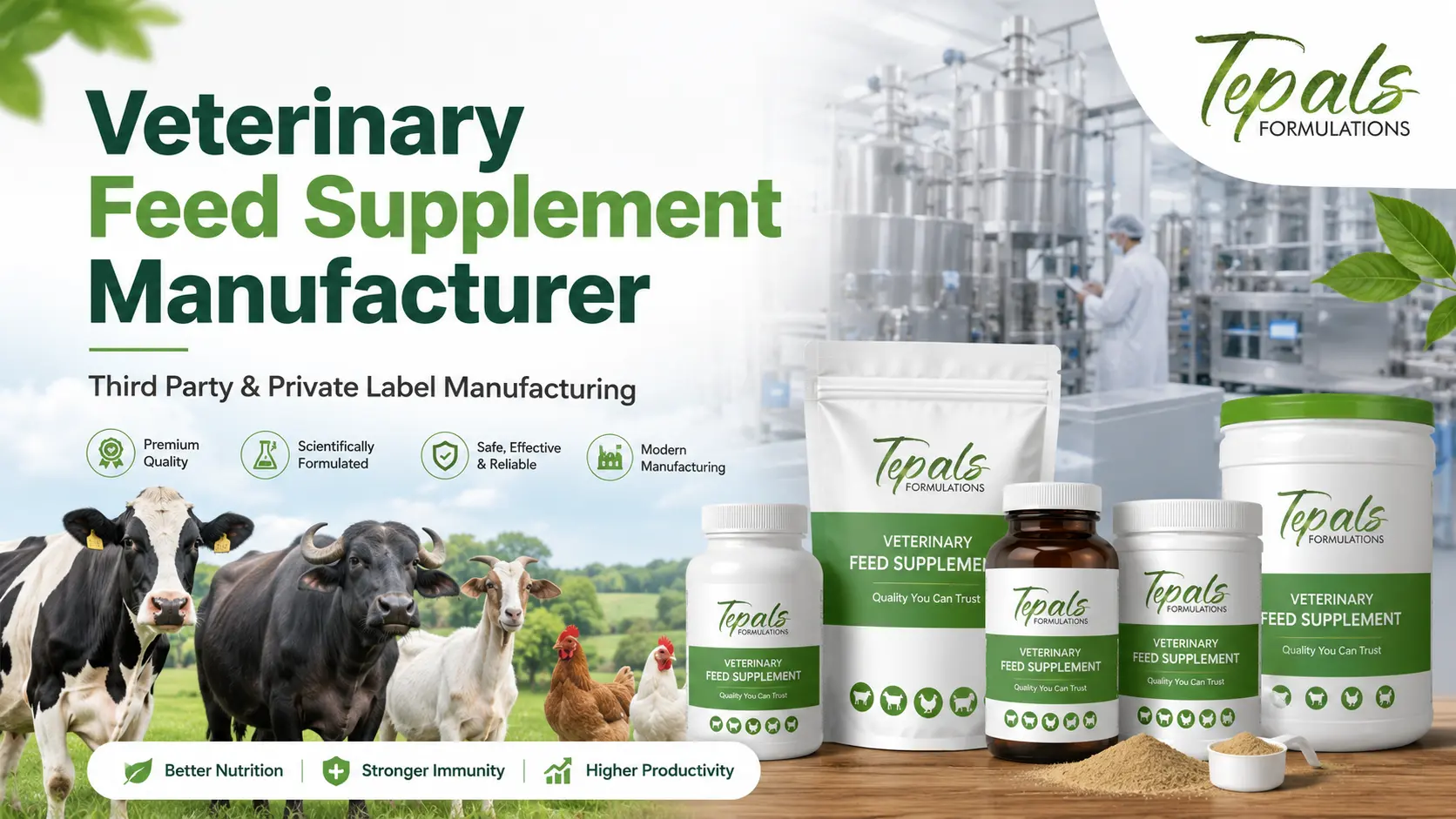
Tepals Formulations provides veterinary manufacturing and third-party production support for businesses seeking to develop and market animal-health products under their own brand. Its service model includes formulation support, bulk production, packaging, labelling, and documentation assistance, subject to product feasibility and applicable regulatory requirements. Is it a Veterinary Feed Supplement?
A veterinary feed supplement is a nutritional product designed to be administered with an animal’s regular feed or drinking water. Depending on its composition, it may supply minerals, vitamins, amino acids, electrolytes, beneficial microorganisms, enzymes, herbal ingredients or other nutritional components.
These products are commonly developed to support:
- Normal growth and development
- Nutritional balance
- Feed utilisation
- Digestive function
- Bone and muscle maintenance
- Reproductive nutrition
- Lactation-stage nutritional requirements
- Recovery from nutritional stress
- General animal performance
Feed supplements should not automatically be described as veterinary medicines. Classification can depend on the formulation, ingredients, intended purpose, route of administration, and claims appearing on the label. Products carrying therapeutic or disease-treatment claims may follow a different regulatory pathway from products intended purely for nutritional supplementation. Veterinary Feed Supplement Manufacturer for Private-Label Brands
A veterinary feed supplement manufacturer develops and produces nutritional products for cattle, buffaloes, calves, goats, sheep, poultry, horses, pets, aqua species, and other animals.
In third-party manufacturing, the brand owner does not need to establish a complete factory. Instead, the brand works with an established production partner to perform the agreed manufacturing activities.
Depending on the project, the process may include:
- Product-concept evaluation
- Composition and ingredient review
- Regulatory classification
- Laboratory or pilot development
- Raw-material procurement
- Commercial manufacturing
- In-process testing
- Filling and packaging
- Finished-product testing
- Batch release and dispatch
This arrangement allows veterinary marketers to concentrate on branding, product promotion, distribution, and customer relationships while the manufacturer handles production.
Why Is Demand for Veterinary Feed Supplements Increasing?
The growing commercial importance of dairy farming, poultry, aquaculture, organised livestock management and companion-animal care supports demand.
Farm owners and veterinary professionals are focusing more on balanced nutrition rather than using conventional feed ingredients.
Commercial customers want targeted formulations for a specific animal, production stage, or nutritional goal. The key demand drivers are:
Greater focus on animal productivity
Commercial dairy and livestock operations keep a close eye on growth, lactation, reproduction, feed intake, and general performance. This drives demand for accurately formulated nutritional products.
Awareness of mineral and vitamin deficiencies
Regular feed may not always contain all the desired micronutrients in the required quantity. Soil quality, fodder composition, animal age, production stage, and seasonal conditions may all affect the nutritional profile of a feeding programme.
Growth of organised dairy and poultry businesses
Bigger farms want consistent products in standardised packaging. They also expect reliable repeat supplies, batch identification, and technical documentation.
Growth of veterinary distribution networks
Distributors and PCD partners are expanding their portfolios beyond veterinary medicines to include nutritional powders, liquids, mineral mixtures, calcium supplements, and other feed-support products.
Rising private-label opportunities
Veterinary marketers can launch differentiated formulations under their own brand without investing in a complete manufacturing facility.
Types of Veterinary Feed Supplements
A veterinary feed supplement portfolio can include several categories. The final ingredients and claims should always be reviewed according to the target species, intended use, and applicable regulations.
1. Mineral mixtures
Mineral mixtures may contain macro and trace minerals such as calcium, phosphorus, magnesium, zinc, copper & manganese, cobalt, and iodine.
The Bureau of Indian Standards publishes specifications for mineral mixtures used to supplement cattle feed. Its product manual for IS 1664 covers areas such as ingredients, guaranteed composition, moisture, ash, selected minerals, microbiological safety, and labelling information. Calcium and phosphorus supplements
These products are commonly used in dairy and livestock nutrition programmes. They may be offered in liquid, powder, gel, or other suitable forms.
The formulation should account for the target animal, feeding programme, ingredient compatibility, and intended nutritional contribution.
3. Vitamin and trace-mineral supplements
Vitamin and mineral combinations may be developed for young animals, breeding animals, dairy cattle, poultry, or general livestock nutrition.
4. Amino-acid supplements
Amino-acid formulations may be used where additional nutritional support is needed for growth, tissue maintenance, or production-stage feeding.
5. Probiotic and prebiotic products
Probiotic, prebiotic, and synbiotic formulations are developed to support the microbial balance associated with normal digestive function.
Manufacturing such products requires careful consideration of strain selection, stability, moisture, temperature, and shelf-life conditions.
6. Enzyme-based feed supplements
Enzymes may be included in certain animal nutrition products to support the breakdown and utilisation of feed components.
Their activity can be affected by processing conditions, storage temperature, moisture and compatibility with other ingredients.
7. Rumen-support products
Products intended for ruminants may contain yeast cultures, buffers, herbal ingredients or other nutritional components designed for rumen-focused feeding programmes.
8. Energy and bypass-fat supplements
Energy supplements and rumen-protected fat products are commonly marketed for high-production dairy animals.
9. Electrolyte supplements
Electrolyte powders and liquids may contain sodium, potassium, chloride, dextrose, and other nutritional ingredients. They are commonly positioned for periods of heat, transportation, or nutritional stress, depending on the approved formulation and claims.
10. Herbal feed supplements
Herbal ingredients may be used in products intended for digestive, liver, udder, respiratory or general nutritional support. Herbal origin does not remove the need for ingredient verification, contaminant control, and accurate label claims.
11. Toxin-management feed additives
Certain products are developed for feed-quality programmes involving mould or mycotoxin risk. The selected ingredients, intended claims, and supporting technical data should be reviewed carefully.
Species-Wise Feed Supplement Categories
| Animal category | Common product opportunities |
| Dairy cattle and buffaloes | Mineral mixtures, calcium liquids, energy supplements, rumen-support powders, vitamins, and trace minerals |
| Calves | Growth-support powders, mineral supplements, probiotics, electrolytes, and milk replacer products |
| Goats and sheep | Mineral mixtures, digestive supplements, nutritional tonics, and general wellness products |
| Poultry | Vitamins, electrolytes, probiotics, enzymes, liver-support products, and mineral premixes |
| Horses | Electrolytes, joint-nutrition products, minerals, amino acids, and performance-support formulations |
| Aqua species | Mineral products, probiotics, water-soluble supplements, and digestive-support formulations |
| Companion animals | Multivitamins, calcium products, probiotics, skin-and-coat products, and joint supplements |
| Swine | Mineral premixes, probiotics, enzymes, amino acids, and growth-stage nutritional products |
A product should not be assumed suitable for every species. Ingredient tolerances, dose requirements, feed patterns, and safety considerations can differ substantially between cattle, poultry, horses, fish, and companion animals.
Available Dosage Forms
Selecting the correct dosage form is an important commercial and technical decision.
| Dosage form | Typical advantages | Important manufacturing considerations |
| Powder | Easy to mix with feed; suitable for bulk packs | Blend uniformity, moisture control, and flowability |
| Granules | Reduced dust and improved handling | Granule strength and ingredient distribution |
| Liquid | Convenient administration and flexible pack sizes | pH, viscosity, sedimentation, and microbial quality |
| Oral suspension | Suitable for insoluble ingredients | Redispersibility and physical stability |
| Gel or paste | Controlled administration for selected animals | Texture, container compatibility, and dose accuracy |
| Bolus or tablet | Measured unit dose | Weight variation, hardness, and disintegration |
| Premix | Suitable for feed mills and bulk users | Accurate low-dose distribution and carrier selection |
Tepals Formulations’ manufacturing information describes veterinary capabilities covering supplements, liquids, powders, boluses, and other animal-health formats. Final availability depends on the required formula, manufacturing category, and technical feasibility. s Formulations: Veterinary Feed Supplement Manufacturer
Tepals Formulations supports veterinary businesses that need a structured route from product idea to finished goods.
The company’s website highlights veterinary manufacturing, custom product development, bulk manufacturing, private labelling, packaging, and regulatory documentation support. It also states that its manufacturing operations use quality-control systems, batch-wise testing, and documented production practices. Manufacturing support under one roof
Working with one coordinated manufacturing partner can reduce delays between formulation, packaging, and commercial production.
The available support may include:
- Product requirement analysis
- Existing formula manufacturing
- Custom formulation development
- Product matching
- Ingredient and dosage-form review
- Sample development
- Packaging selection
- Label and artwork coordination
- Bulk production
- Batch-wise quality checks
- Finished-product documentation
- Pan-India supply support
Private-label veterinary manufacturing
Private-label manufacturing enables a distributor or marketing company to launch veterinary supplements under its own brand name.
The product may carry the marketer’s:
- Brand name
- Logo
- Product positioning
- Packaging design
- Contact details
- Distribution information
Manufacturing and marketing details should be declared correctly according to applicable requirements.
Custom formulation development
A generic formulation may not suit every market. A dairy-focused distributor may require a different product portfolio from a poultry, aqua, or companion-animal business.
Customisation can involve:
- Ingredient selection
- Ingredient strength
- Product flavour
- Colour and appearance
- Powder or liquid format
- Target pack size
- Intended species
- Price positioning
- Packaging format
- Label communication
Customisation remains subject to ingredient compatibility, stability, legal classification, and manufacturing feasibility.
Flexible packaging support
Veterinary feed supplements may be supplied in:
- HDPE bottles
- PET bottles
- Jars
- Pouches
- Laminated bags
- Sachets
- Buckets
- Drums
- Bulk containers
The right packaging protects the product from moisture, oxygen, light, contamination, and physical damage. Packaging should therefore be selected during product development rather than after manufacturing has been completed.
Manufacturing Process of Veterinary Feed Supplement
A professional manufacturing process should establish a traceable route from incoming raw materials to the release of the finished batch.
Step 1: Requirement assessment
The manufacturer collects information about:
- Target species
- Intended nutritional purpose
- Proposed composition
- Dosage form
- Pack size
- Order quantity
- Target price
- Label claims
- Distribution market
A complete brief reduces formulation changes and packaging delays.
Step 2: Technical and regulatory review
Proposed ingredients and claims are reviewed for technical feasibility and likely regulatory classification.
This step is especially important where the proposed product makes disease-related, therapeutic, or medicinal claims.
Step 3: Formula development
The technical team will formulate or evaluate the proposed formula. This includes evaluation of ingredient compatibility, stability, dose accuracy, and palatability in the animal.
Step 4: Sample approval
A trial sample may be prepared to confirm:
- Colour
- Odour
- Taste or flavour
- Texture
- Solubility
- Viscosity
- Sedimentation
- Packaging compatibility
Commercial production should begin only after the agreed specifications are approved.
Step 5: Raw-material control
Raw materials should be procured from evaluated vendors. Incoming materials are generally identified, sampled, tested, and released before being used in production.
Step 6: Dispensing and manufacturing
Approved ingredients are weighed according to the batch record.
Powder manufacture may involve sifting, premixing, and sequential blending. Liquid manufacture may involve controlled mixing, heating, cooling, homogenisation, or filtration. Low-dose vitamins and trace ingredients often need to be premixed closely to achieve a uniform distribution.
Step 7: In-process quality checks
Depending on the product, checks may include:
- Appearance
- Colour and odour
- pH
- Viscosity
- Specific gravity
- Blend uniformity
- Moisture
- Fill volume
- Net weight
- Mixing time
- Batch yield
Step 8: Filling and packaging
The approved bulk product is transferred to suitable containers. Containers, closures, labels, and batch coding are checked before production filling equipment.
Step 9: Finished-product testing
Finished-product checks may cover identity, composition, pH, viscosity, moisture, microbiological quality, net content, and packaging integrity.
The exact testing plan depends on the formula and product specification.
Step 10: Quality review and release
Quality assurance reviews the production and testing records before authorising release.
Tepals Formulations’ published manufacturing process describes raw-material release, documented dispensing, in-process testing, packaging reconciliation, finished-product testing, and batch traceability as important manufacturing controls. Key Parameters Buyers Should Evaluate
A low quotation should not be the only selection criterion. Buyers should examine whether the manufacturer has systems capable of delivering repeatable quality.
Raw-material specifications
Ask how incoming ingredients are identified and tested. The same ingredient can vary by source, grade, and purity.
Formula and batch consistency
The manufacturer should use an approved master formula and documented batch instructions.
Measuring-equipment calibration
Balances, filling equipment, pH meters, and other instruments should be maintained and calibrated.
Microbiological controls
Water-based liquids, probiotics, and certain natural ingredients may require additional microbial monitoring.
Packaging compatibility
A formula can interact with its bottle, cap, liner, or pouch. Leakage, colour change, moisture absorption, and ingredient degradation may occur when packaging is unsuitable.
Finished-product specifications
The product should have clearly defined acceptance criteria rather than relying only on visual inspection.
Traceability
The product should have clearly defined acceptance criteria rather than relying only on visual inspection.
Complaint handling
The manufacturer and marketer should agree on how complaints, returns, deviations, and possible recalls will be handled.
Documents to Request from a Manufacturer
Document requirements vary by product and commercial agreement. Commonly requested documents include:
- Company profile
- Relevant manufacturing permissions
- Tax and business registrations
- Product specification
- Certificate of analysis
- Batch manufacturing records(where contractually applicable
- Raw-material specifications
- Packaging specifications
- Stability information
- Artwork approval
- Manufacturing agreement
- Non-disclosure agreement
- Dispatch and batch details
A buyer should verify the documents relevant to the exact formulation instead of assuming that one licence or certificate covers every veterinary product category.
How to Choose the Right Veterinary Feed Supplement Manufacturer
Use the following checklist before placing a commercial order.
1. Confirm relevant manufacturing capability
A company experienced in liquids may not necessarily have suitable facilities for probiotics, mineral mixtures, boluses, or sterile products.
2. Evaluate the quality system
Review raw material control, production records, testing facilities, batch release, and complaint procedures.
3. Ask for formulation transparency
The commercial proposal should clearly state ingredient strengths, dosage form, pack size, testing scope, and other agreed specifications.
4. Check regulatory classification
Do not approve disease-treatment claims for a nutritional product without appropriate technical and regulatory review.
5. Review minimum order quantity
MOQ can differ according to batch size, packaging, printed material, ingredient quantity, and product format.
6. Approve packaging before production
Bottle shape, closure, liner, label size, pouch structure, and carton dimensions should be finalised before bulk production.
7. Discuss delivery realistically
New formulations can require development, sample approval, raw material procurement, and packaging preparation. Repeat orders are generally easier to schedule.
8. Sign a manufacturing agreement
The agreement should cover specifications, quality responsibilities, artwork, confidentiality, rejected goods, delivery terms, and complaint handling.
9. Evaluate communication
A manufacturing partner should provide clear updates about sample approval, material availability, production status, and dispatch.
10. Begin with a focused range
Launching a smaller, carefully selected portfolio is usually more manageable than introducing a very large range without sufficient market validation.
What Determines Veterinary Feed Supplement Manufacturing Cost?
There is no universal price for private-label manufacturing. Cost is influenced by:
- Ingredient selection and strength
- Raw-material market price
- Product dosage form
- Batch quantity
- Testing requirements
- Packaging material
- Bottle, jar, pouch or bucket size
- Printed labels and cartons
- Custom formulation work
- Stability requirements
- Freight destination
- Taxes and commercial terms
Comparing quotations only by cost per bottle or kilogram can be misleading. Two products with similar names may have different ingredient strengths, packaging quality, testing scopes, and commercial conditions.
Who Can Work with Tepals Formulations?
Veterinary feed supplement manufacturing services may be suitable for:
- Veterinary product distributors
- PCD franchise businesses
- Animal-health marketing companies
- Dairy-sector suppliers
- Poultry product distributors
- Feed dealers
- Livestock product wholesalers
- Veterinary doctors launching a brand
- E-commerce veterinary businesses
- Export-oriented marketers
- Existing companies expanding their product portfolio
- New veterinary startups
Tepals Formulations is based in Ambala, Haryana, and provides manufacturing enquiry support through its official website, phone, and email channels. The company lists private labelling, custom development, packaging, and bulk manufacturing among its services. Partner with Tepals Formulations?
A suitable manufacturing partner should combine technical capability with responsive commercial support.
Tepals Formulations positions its services around:
- Veterinary product manufacturing
- Third-party and private-label production
- Custom product development
- Bulk manufacturing
- Packaging and labelling support
- Batch-wise quality control
- Documentation assistance
- Scalable supply
- Pan-India business support
The company’s website also highlights advanced infrastructure, ISO-GMP-certified units, strict quality controls, and timely supply as key manufacturing strengths. However, these credentials should be verified against the specific manufacturing unit and product category during commercial due diligence. Ultimately, your Veterinary Feed Supplement Brand
A successful veterinary supplement brand begins with more than an attractive label. In fact, it requires a relevant product concept, a technically workable formulation, appropriate packaging, clear documentation, and a reliable supply partner.
Before requesting a quotation, prepare the following details:
- Product category
- Target animal species
- Preferred composition
- Powder, liquid, or other dosage form
- Required pack size
- Expected order quantity
- Target market
- Private-label requirements
- Packaging preference
- Expected price positioning
Sharing a detailed requirement allows Tepals Formulations to assess feasibility and provide a more accurate manufacturing proposal.
Conclusion
Choosing the right veterinary feed supplement manufacturer is crucial because it can determine whether a product consistently performs in the market. Moreover, it affects whether the brand can scale without repeated supply or quality problems.
A dependable manufacturer should provide more than bulk production. In addition, it should support formulation review, raw-material control, process documentation, packaging selection, quality testing, batch traceability, and reliable delivery.
Tepals Formulations offers third-party and private-label veterinary manufacturing support for distributors, marketers, and animal-health companies. The company provides custom product development, packaging support, and scalable manufacturing services to help companies transform veterinary nutrition ideas into market-ready products.
Frequently Asked Questions
1. What does a veterinary feed supplement manufacturer do?
A veterinary feed supplement manufacturer is a company that develops, manufactures, tests, and packages nutritional products for animals. It may also provide private labelling, custom formulation, packaging selection, and documentation support.
2. Does Tepals Formulations provide third-party veterinary manufacturing?
Yes. Tepals Formulations offers veterinary third-party manufacturing, private labelling, custom product development, bulk manufacturing, packaging, and labelling.
What veterinary feed supplements can be produced? Potential categories include mineral mixtures, calcium supplements, multivitamins, amino acid products, electrolytes, probiotics, enzymes, energy supplements, and herbal formulations.
3. Can I launch veterinary feed supplements under my brand name?
Yes. Private-label manufacturing enables a product to be manufactured and packaged under the marketer’s brand, as long as the formulation is approved, there is a commercial agreement, and the artwork is compliant.
5. What is the MOQ for veterinary feed supplements?
The minimum order quantity will depend on product form, batch size, ingredients, pack size, and type of packaging material. Printed pouches, labels, cartons, and bespoke containers may affect the quantity required.
6. Do you do custom veterinary formulations?
Custom formulations can be developed after review of target species, proposed ingredients, intended use, pack size, expected price, and relevant regulatory requirements.
7. Are feed supplements the same as veterinary medicines?
Not always. Product classification depends on the composition, intended use and label claims. A product marketed for nutritional support may follow a different route from one carrying disease-treatment or therapeutic claims.
8. Are quality tests performed on feed supplements?
Testing can include appearance, pH, viscosity, moisture, blend uniformity, ingredient identification, microbial quality, net content, and packaging integrity. The actual tests depend on the formulation and dosage form.
9. How long does veterinary supplement manufacturing take?
The timeline depends on formula development, sample approval, raw material availability, packaging preparation, testing, batch size and production scheduling. A repeat batch may require less preparation than a completely new product.
10. What information is needed for a manufacturing quotation?
Provide the product name, proposed composition, dosage form, pack size, quantity, target species, packaging requirement, and branding details.
11. Can the manufacturer help with packaging design?
Tepals Formulations states that it offers packaging and labelling support for private-label and third-party manufacturing projects. Who should decide the recommended animal dosage?
Dosage should be established through appropriate technical review and should consider the product composition, species, age, body weight, feeding conditions, and intended use. Veterinary or animal-nutrition guidance should be obtained where necessary.