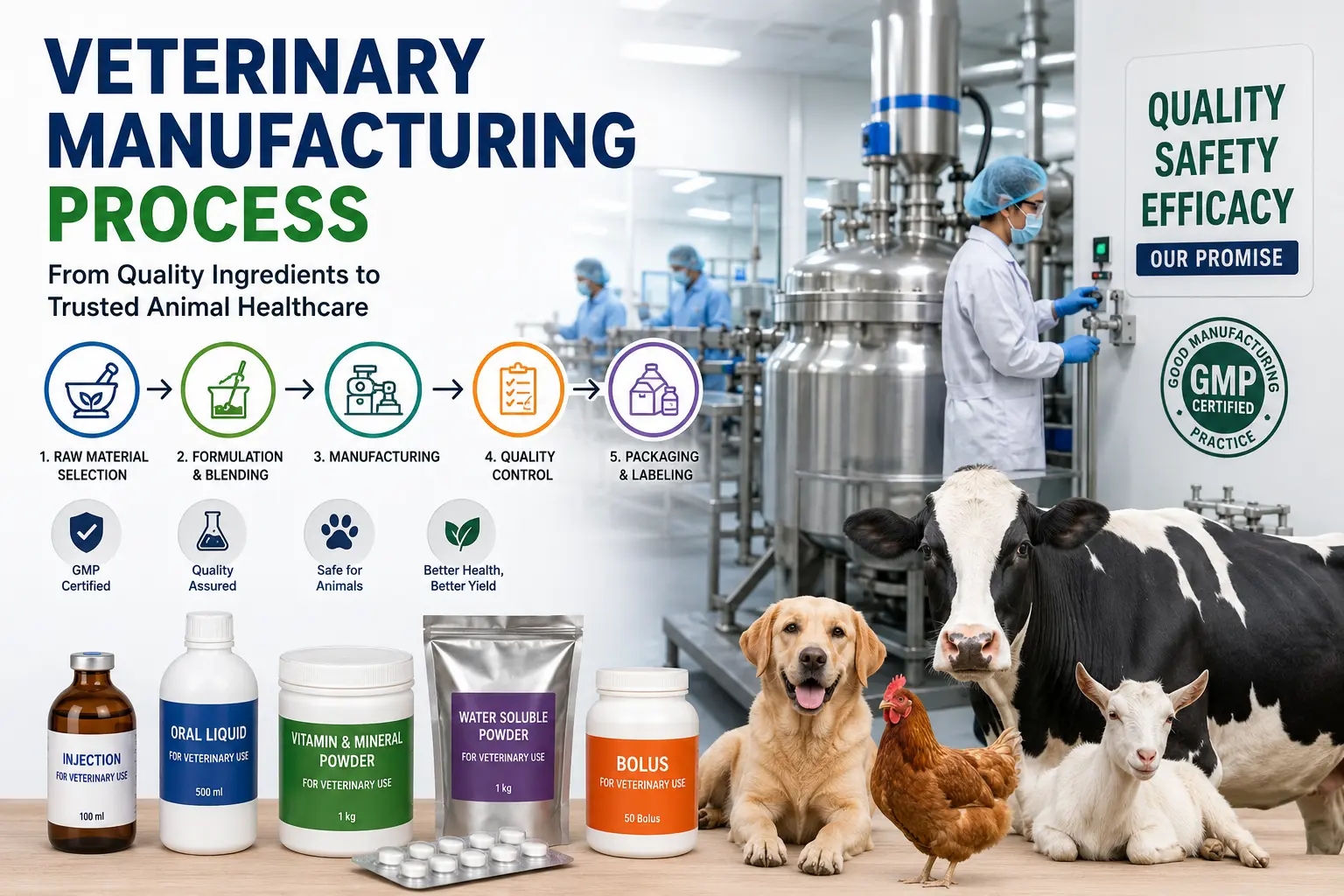
The veterinary manufacturing process is a controlled system used to develop, produce, test, pack, and release products intended for animal health or nutrition. It can cover veterinary medicines, boluses, oral liquids, powders, feed supplements, topical products, injectables, and biologicals. However, these products do not all follow the same regulatory pathway.
For a veterinary brand owner, distributor or startup, understanding the process is essential for product quality, legal compliance and batch-to-batch consistency. A good formula alone is not enough. The manufacturer must also control raw materials, equipment, production conditions, testing, packaging and documentation.
Process at a glance: Product concept → classification → formulation → raw-material approval → dispensing → manufacturing → in-process checks → packaging → finished-product testing → QA release → dispatch.
What Is the Veterinary Manufacturing Process?
The veterinary manufacturing process is the documented sequence through which an animal-health product moves from an approved concept to a market-ready batch.
The requirements for each stage and standard operating procedures have been put in place. The objective is to ensure that the finished product has the intended identity, strength, purity, stability and performance.
Product Classification Comes Before Manufacturing
The correct product category should be established before finalising the formula, product label or manufacturing site.
A product should not be described as a “feed supplement” merely to avoid drug-related requirements.
Classification can depend on:
- Ingredients and concentration
- Intended purpose
- Route of administration
- Target animal species
- Recommended dosage
- Therapeutic or nutritional claims
For example, a product supporting routine mineral nutrition may follow a different pathway from one claiming to treat milk fever, infection, parasitic disease or another medical condition.
Step-by-Step Guide Veterinary Manufacturing Process
1. Product requirement analysis
Manufacturing begins with a detailed product brief. The brand owner and manufacturer should define:
- Target animal species
- Intended product benefit
- Dosage form
- Proposed composition and strength
- Pack size
- Expected order quantity
- Storage conditions
- Target price range
- Label claims
- Distribution market
A clear brief prevents expensive changes after formulation trials, packaging development or artwork approval.
2. Formulation Development
The research and development team converts the commercial idea into a technically workable formula.
Depending on the product, the formulation may contain active pharmaceutical ingredients, minerals, vitamins, amino acids, herbs, excipients, flavours, binders, stabilisers, preservatives or carriers.
Veterinary formulation development must consider animal acceptability, dose accuracy, ingredient compatibility and product stability.
For example:
- A powder requires good flow and uniform ingredient distribution.
- Oral suspension should possess appropriate viscosity and redispersability.
- A bolus should be adequately hard and disintegrate properly.
- A topical product must remain compatible with the selected container.
- A liquid supplement should not settle, separate or degrade during storage.
Laboratory trials are normally completed before the formulation is transferred to commercial-scale production.
3. Regulatory and Technical Review
Before production starts, the regulatory team checks the proposed composition, manufacturing licence category, product permissions, statutory declarations, testing requirements and label claims.
For many conventional drugs outside the specified scheduled categories, the Drugs Rules describe Form 24 as the manufacturing licence application and Form 25 as the corresponding licence. The rules also provide a loan-licence route for businesses using the facilities of an existing licensed manufacturer. Biologicals, sterile products and other scheduled categories may require different forms and approvals.
The exact route should always be confirmed according to the product category and the requirements of the relevant licensing authority.
4. Raw-Material Procurement and Testing
The manufacturer buys active ingredients, vitamins, minerals, herbs, excipients and packaging components from approved vendors.
Upon arrival at the facility the materials are:
- Checked against the purchase documents.
- Assigned a receipt or lot number.
- Placed in a quarantine area.
- Sampled by authorised quality personnel.
- Tested against approved specifications.
- Released or rejected by the quality control department.
Only approved materials should be brought into the production area. Rejected materials should be clearly identified and segregated to prevent inadvertent use.
5. Line Clearance & Dispensing
Production receives the approved batch manufacturing record, which contains the formula, instructions on batch processing, and details on the expected batch yield.
Dispensing of raw materials occurs in a designated area, and raw materials are recorded after being placed on a calibrated balance. The material name, supplier batch number, internal lot number, and quantity dispensed are recorded.
Clearing a manufacturing line helps ensure the following:
- All manufacturing spaces are orderly.
- All manufacturing equipment is clean.
- All materials from the previous product have been removed.
- All documents from the previous manufacturing batch have been removed.
- All documents and materials required for the current product and batch are available.
This also helps ensure the correct product is manufactured and that the product has not been contaminated.
6. Manufacture according to form of dosage
The core manufacturing activity depends on the veterinary product.
Feed Supplements and Powders
Usually ingredients are sifted, pre-blended and added in a specified sequence. Vitamins, trace minerals and other low-dose ingredients may first be converted into a premix to achieve uniform distribution.
Boluses and Tablets
The process may include:
- Sifting
- Mixing
- Granulation
- Drying
- Lubricaion
- Compression
- De-dusting
- Inspection
In production, weight variation, hardness, thickness and disintegration are usually monitored.
Oral Solutions and Suspensions
Liquid base, approved, is transferred to a manufacturing vessel. Ingredients are introduced under controlled mixing, temperature and time conditions.
The batch can then be homogenised, filtered, deaerated or held prior to filling.
Topical Products & Disinfectants
Mixing order, active concentration, pH and compatibility with packaging are important. The final product must be stable in the selected bottle, container or closure.
Sterile Products and Veterinary Biologics
Injectables, vaccines and other sterile or biological products need specialised facilities, validated sterilisation or aseptic processes, environmental controls and stricter contamination-prevention systems. CDSCO provides separate guidance for veterinary biological products and approval requirements.
7. In-Process Quality Control
Quality should be checked throughout production rather than only after the batch has been completed.
Depending on the dosage form, in-process checks may include:
- Appearance, colour and odour
- Blend uniformity
- pH
- Viscosity
- Specific gravity
- Fill volume
- Net weight
- Bolus or tablet hardness
- Disintegration time
- Mixing temperature
- Mixing duration
- Batch yield
- Packaging reconciliation
Results are recorded in the batch document. An out-of-limit result should be investigated instead of being corrected through an undocumented adjustment.
8. Filling, Packaging and Labelling
Then the bulk product is approved. Then it goes to the filling and packaging area.
Containers and closures are checked for cleanliness, specifications and compatibility. Filling equipment is calibrated and checked prior to the commencement of routine production.
Labels and cartons shall bear the proper applicable information including:
- Product Name Ingredients
- Net content quantity
- Batch number.
- Date of manufacture
- Expiration date:
- How to Store
- How to use Manufacturer details
- Required warnings or precautions
Printed packaging materials must be tightly controlled and reconciled. A product with an incorrect label can create significant safety and recall issues.
9. Finished-Product Quality Testing
Quality control collects representative samples from the packed batch and tests them against the approved finished-product specifications.
The tests depend on the product but may include:
- Identification of ingredients
- Assay or active concentration
- Uniformity
- Moisture content
- pH
- Viscosity
- Microbial quality
- Disintegration
- Fill volume
- Net weight
- Packaging integrity
Stability studies are used to evaluate whether the product continues to meet its specifications throughout the proposed shelf life in the intended market pack.
This is why packaging should be selected as part of product development rather than treated only as a branding decision.
10. Quality-Assurance Review and Batch Release
Quality control performs laboratory testing, while quality assurance reviews the complete history of the batch.
The QA department verifies:
- Raw-material release status
- Dispensing records
- Equipment cleaning records
- Manufacturing instructions
- In-process test results
- Deviations and investigations
- Batch yield
- Packaging reconciliation
- Finished-product test reports
The batch is released only after authorised personnel confirm that production and testing were completed according to the approved procedures
11. Storage, Dispatch and Traceability
Released products are transferred to the finished-goods warehouse and stored under appropriate conditions.
The warehouse should prevent:
- Product mix-ups
- Physical damage
- Moisture exposure
- Contamination
- Dispatch of unreleased stock
- Dispatch of expired products
Distribution records connect each customer order with the relevant batch number. This traceability helps the company investigate complaints and conduct a targeted recall when necessary.
12. Complaints and Post-Market Monitoring
The veterinary manufacturing process does not end after dispatch.
Manufacturers and marketing companies need written procedures for:
- Product complaints
- Adverse-event information
- Returned goods
- Suspected product defects
- Batch recalls
- Corrective and preventive action
Revised Schedule M principles also emphasise systems for collecting and processing safety information arising from products manufactured or marketed by a licensee.
Third-Party Veterinary Manufacturing Process
Under third-party veterinary manufacturing, a veterinary brand outsources production to an external manufacturing facility.
The usual commercial workflow is:
- Share the composition, dosage form, pack size and quantity.
- Confirm technical feasibility and regulatory classification.
- Review the quotation and minimum order quantity.
- Approve the formulation, sample and specifications.
- Submit required business and product documents.
- Approve the label and carton artwork.
- Place the purchase order.
- Manufacture and test totally.
- Get approved by QA.
- Receive the finished batch and the agreed documentation.
A written manufacturing agreement should outline who owns the formulae, who is responsible for artwork, what quality standards need to be met, testing, rejection handling, delivery terms, confidentiality and complaint management.
Frequently Asked Questions
1. What is a veterinary manufacturing process?
It is the controlled sequence used to formulate, produce, test, pack and release an animal-health product. It includes raw-material control, documented production, quality testing, QA approval and batch traceability.
2. What is the license needed for manufacturing veterinary medicines in India?
The licence depends on the category of product. For many conventional drugs the route is Form 24 application and Form 25 licence but for biologicals, sterile products and other scheduled categories, different forms and permissions may be needed.
3. Veterinary feed supplements are not veterinary medicines
No. Classification depends on the ingredients, the intended use of the product, the route of administration, and the label claims. “[A] nutritional product and a medicine may follow different standards and licensing pathways.
4. What is the lead time of production of veterinary products?
The timeline depends on formulation development, regulatory permissions, raw-material availability, testing, packaging approval, batch size and production scheduling. Repeat batches are usually quicker than new custom formulations.
5. What does third-party veterinary manufacturing mean?
This is a situation in which a brand owner contracts with an outside manufacturer to produce veterinary products under the brand owner’s name.
6. What tests of quality are conducted on veterinary products?
Tests typically run are: identity, assay, pH, viscosity, moisture, uniformity, microbial quality, disintegration, fill volume, net weight, and packaging integrity. Specific tests depend on the dosage form.
7. What is the significance of GMP to veterinary manufacturing?
GMPs control facilities, personnel, equipment, sanitation, raw materials, production records and quality systems. It helps to decrease contamination, mix-ups, un-documented changes and inconsistent batches.
8. Can a manufacturer produce a veterinary formulation to order?
Yes, provided that technical feasibility, regulatory classification, ingredient compatibility and available manufacturing permissions are met. In commercial production, it may be necessary to carry out trial development and stability studies.
Conclusion:
The manufacturing of veterinary products is much more than just mixing ingredients and filling containers. This includes regulatory classification, formulation development, supplier control, documented production, in process controls, laboratory testing, compliant packaging, QA release and batch traceability.
Companies entering veterinary medicines or animal nutrition should first verify the right product category. They should then choose a manufacturer with proper facilities, trained technical personnel, reliable quality systems and experience with the required dosage form.