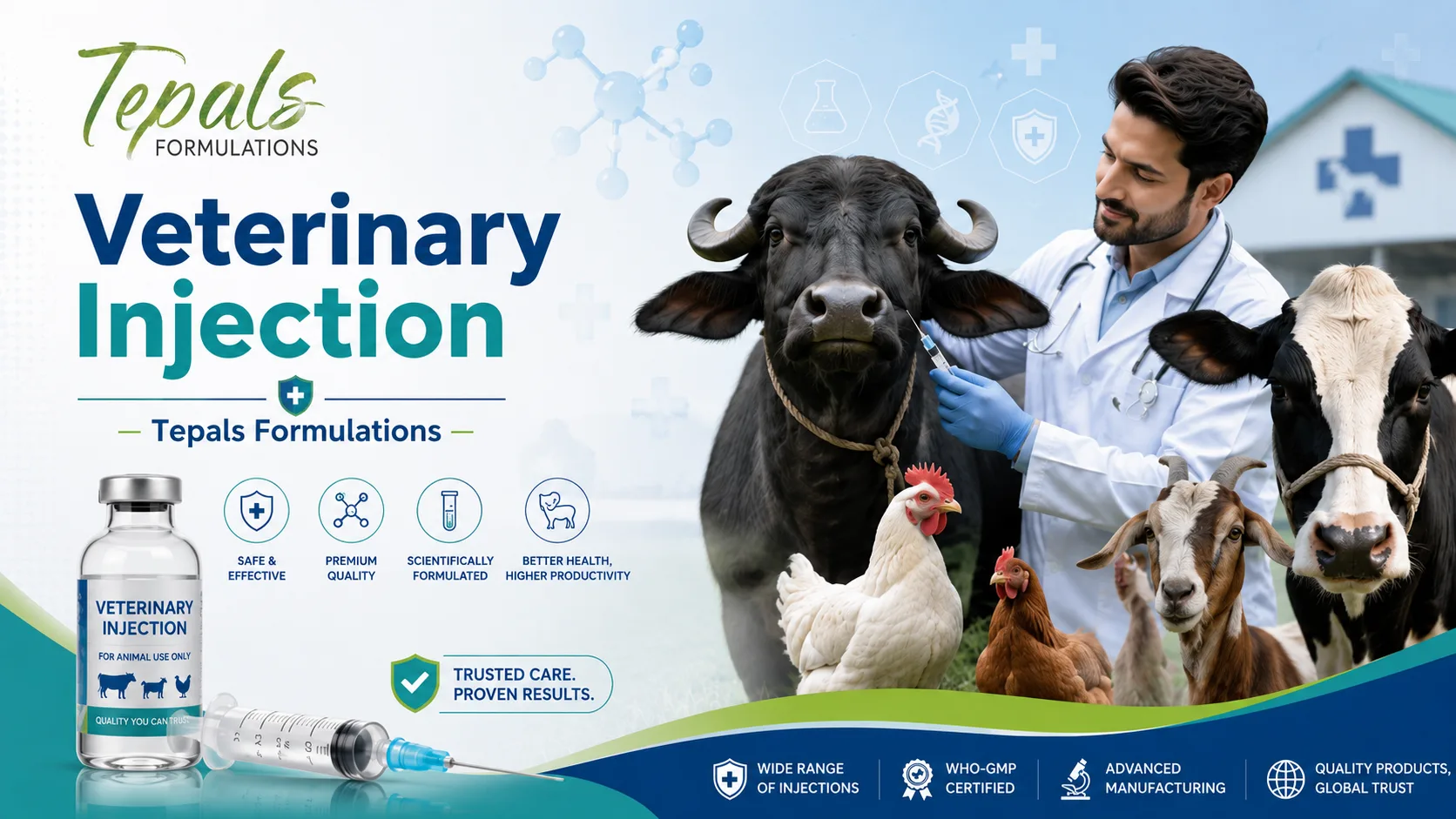
A veterinary injection is an injectable medicinal or biological formulation developed for administration to animals through an approved parenteral route. Depending on the formulation, it may be used in livestock, poultry, horses, or companion animals for disease treatment, pain management, nutritional support, parasite control, reproduction management, or preventive healthcare.
Veterinary injections can be valuable when an animal cannot take oral medicine, a precisely measured dose is needed, or the selected medicine must be delivered through a particular route. However, an injection is not automatically better than an oral medicine. The appropriate product, dose, route, and treatment duration depend on the animal species, body weight, medical condition, product label, and veterinary assessment.
For distributors and animal-health companies, veterinary injectables also represent a specialised product category. The formulation, sterile processing, compatible packaging, documented testing, and appropriate regulatory permissions that are required for injectable manufacturing are not needed for routine oral products.
Important: This article provides general educational and business information. It does not recommend any medicine or dosage. Veterinary injections should be selected and administered only by a qualified veterinarian or an appropriately trained person acting under veterinary direction.
What Is a Veterinary Injection?
A veterinary injection is a sterile preparation intended to deliver an active ingredient into an animal’s body without passing through the normal digestive route. Injectable products may be manufactured as ready-to-use solutions, suspensions, emulsions, or sterile powders that require reconstitution before administration.
The principal parenteral routes used in veterinary medicine include intravenous, intramuscular, subcutaneous, and intra-articular administration. The correct route depends on the formulation, product approval, animal species, and clinical purpose.
A veterinary injection may contain:
- An antimicrobial active ingredient
- An anti-inflammatory or analgesic ingredient
- An antiparasitic ingredient
- Vitamins, minerals, or metabolic-support ingredients
- Hormonal or reproductive-health ingredients
- A vaccine, antigen, or other biological substance
- Anaesthetic or emergency-care ingredients
Products from different categories should never be treated as interchangeable. A medicine formulated for one species, strength, or route may be unsuitable for another animal.
Common Types of Veterinary Injections
Veterinary injectable medicines can be divided into several therapeutic categories. The following descriptions explain their general purposes without recommending individual treatment.
1. Veterinary Antibiotic Injections
Veterinary antibiotic injections are developed for susceptible bacterial infections diagnosed or reasonably suspected by a veterinarian.
They may be considered when:
- The infection requires systemic treatment
- Oral administration is impractical
- The animal is not eating or swallowing properly
- A particular injectable formulation is clinically appropriate
- Accurate individual dosing is necessary
Antibiotic injections should not be used for viral diseases or as a substitute for hygiene, vaccination, nutrition, and farm biosecurity. WOAH guidance recommends that veterinary antimicrobials be used responsibly, with attention to diagnosis, approved indications, dosage regimen, administration route, and withdrawal requirements.
2. Analgesic and Anti-Inflammatory Injections
These veterinary injections may be used under professional supervision for the management of pain, inflammation, or fever associated with an illness, injury, operation, or other veterinary condition.
The choice of active ingredient is important because suitability can vary by species and physiological condition. Buyers should also verify the current regulatory position of every ingredient. For example, CDSCO’s Drugs Rules page records Indian notifications concerning the prohibition of certain veterinary drugs and formulations.
3. Antiparasitic Injections
Injectable antiparasitic formulations may be used against specified internal or external parasites when approved for the target animal and parasite.
Product selection should consider:
- Parasite species
- Animal species
- Body weight
- Local resistance patterns
- Previous treatment history
- Approved dose and route
- Meat or milk withdrawal period
Repeated, unsupervised use of the same antiparasitic compound can encourage resistance and reduce long-term treatment effectiveness.
4. Vitamin and Mineral Injections
Nutritional veterinary injections may contain vitamins, minerals, or metabolic-support ingredients. Depending on their approved formulation, these products may be used to address a diagnosed deficiency or support recovery under veterinary advice.
Examples of injectable nutritional categories include:
- B-complex vitamins
- Vitamin A, D, or E preparations
- Iron preparations
- Calcium and magnesium formulations
- Phosphorus-related formulations
- Amino-acid or metabolic-support preparations
These products should not be viewed as routine substitutes for balanced feeding. Deficiency signs may resemble infectious, metabolic, or reproductive conditions, so professional diagnosis remains important.
5. Hormonal and Reproductive Injections
Some injectable veterinary products are developed for reproductive-health protocols, fertility management, or specific hormonal conditions.
These are specialised prescription-led products. Their use may depend on:
- The animal’s reproductive status
- Pregnancy status
- Stage of the reproductive cycle
- Species and age
- Veterinary diagnosis
- Farm breeding programme
- Approved treatment protocol
Improper hormonal use can lead to ineffective results, adverse outcomes, and unnecessary costs.
6. Veterinary Vaccines and Biological Injections
Vaccines and biological products help prevent particular animal diseases by stimulating an immune response or providing another defined biological action.
These products differ substantially from conventional pharmaceutical injections. They may require dedicated manufacturing permissions, validated cold-chain conditions, biological testing, and carefully controlled transportation.
India’s Drugs Rules classify products such as sera, vaccines, antigens, toxins, and antitoxins within biological and special-product categories, illustrating why their regulatory pathway should not be assumed to be the same as a standard liquid injection.
7. Emergency and Supportive-Care Injections
Veterinary professionals may use injectable supportive-care products in emergencies or when oral treatment is unsuitable. Depending on the case, this category can include fluid, electrolyte, anaesthetic, or other critical-care preparations.
Such products are generally used in a veterinary hospital, clinic, or controlled farm setting because rapid monitoring may be required.
Routes of Veterinary Injection Administration
The injection route directly affects absorption, onset, safety, and suitability. A medicine labelled for one route should not be administered through another route unless specifically directed by an authorised veterinarian in accordance with applicable law.
| Injection route | Meaning | General application |
|---|---|---|
| Intravenous | Administered into a vein | Used when direct vascular administration is required |
| Intramuscular | Administered into muscle tissue | Common for products designed for absorption through muscle |
| Subcutaneous | Administered beneath the skin | Used for products approved for slower absorption under the skin |
| Intra-articular | Administered into a joint | Specialised procedure normally performed by a veterinarian |
| Intradermal | Administered into the skin | Used for particular tests or approved biological products |
| Intramammary | Administered into the mammary system | Specialised dairy-animal products rather than a routine needle injection |
Merck Veterinary Manual identifies IV, IM, SC, and intra-articular administration among the main parenteral routes and notes that veterinary dosage-form decisions are affected by species, body size, husbandry practices, residues, and practical handling considerations.
Veterinary Injections for Different Animal Categories
Cattle and Buffaloes
Veterinary injections for cattle and buffaloes may be used within professional treatment programmes for infectious diseases, parasite control, metabolic disorders, pain management, nutritional deficiencies, and reproductive conditions.
Dairy-animal treatment requires particular attention to:
- Milk withdrawal or discard instructions
- Meat withdrawal period
- Lactation status
- Pregnancy status
- Injection-site selection
- Accurate body-weight estimation
- Complete treatment records
Sheep and Goats
Small ruminants require species-appropriate and weight-based treatment. A dose calculated for cattle must not be reduced casually and applied to a goat or sheep.
Wool, skin thickness, body condition, parasite resistance, and the intended food use of the animal may influence treatment planning.
Poultry
Veterinary injections in poultry may be used for selected individual-bird treatments, breeder operations or vaccination programmes. Many poultry health interventions also use other routes such as drinking water, spray, eye drop or in-ovo administration.
The correct delivery method depends on the product and flock-health programme.
Dogs and Cats
Companion-animal injections are commonly administered in veterinary clinics. Injectable categories can include vaccines, antibiotics, pain medicines, anaesthetics, antiparasitics, and supportive-care products.
A livestock formulation should never be used in a dog or cat merely because it contains a familiar active ingredient. Concentration, excipients, approved species, dose, and safety profile may be different.
Horses
Equine injections require careful attention to injection route, site preparation, restraint, and product suitability. Some procedures, including intra-articular treatment, are specialised veterinary interventions.
Liquid and Dry-Powder Veterinary Injections
Veterinary injectable products are not manufactured in one standard format.
Liquid Injection
A liquid injection may be supplied as a ready-to-use solution, suspension, or emulsion.
Potential advantages include:
- No reconstitution step for ready-to-use products
- Convenient measurement
- Faster preparation in clinical settings
- Availability in single-dose or multidose packs
The formulation must remain physically and chemically stable throughout its approved shelf life.
Dry-Powder Injection
A dry-powder injection is supplied as sterile powder and reconstituted with the specified diluent before use.
This presentation may be selected when the active ingredient does not have adequate long-term stability in an aqueous product. The prepared solution or suspension must be used according to its defined in-use storage period.
Commercial injectable portfolios commonly separate liquid and dry-powder veterinary injections because their manufacturing processes, packaging configurations, and stability requirements are different.
Veterinary Injection Manufacturing Process
Veterinary injection manufacturing demands tighter contamination control than many non-sterile dosage forms. The exact process varies according to product composition, sterilisation method, container type, and regulatory classification.
1. Product Requirement Analysis
The brand owner and manufacturer first define:
- Target animal species
- Therapeutic category
- Proposed composition
- Product strength
- Dosage form
- Administration route
- Pack size
- Target market
- Required documentation
- Expected order quantity
- Storage conditions
Tepals Formulations’ veterinary manufacturing guide also recommends establishing the target species, purpose, composition, pack size, storage conditions, and label claims before production planning begins.
2. Regulatory and Technical Feasibility
The proposed product must be checked against:
- Current regulatory status of the ingredients
- Manufacturing licence category
- Product permissions
- Approved claims
- Target-species requirements
- Labelling rules
- Testing requirements
- Applicable pharmacopoeial standards
Injectables, biologicals, and nutritional products should not automatically be treated as the same regulatory category.
3. Formulation Development
The development team determines whether the product should be:
- A clear solution
- A suspension
- An emulsion
- A long-acting preparation
- A sterile powder requiring reconstitution
Development work may examine solubility, pH, compatibility, preservative effectiveness where relevant, container interaction, physical stability and active-ingredient degradation.
4. Raw-Material Qualification
Active ingredients and excipients should be sourced against defined specifications. Incoming materials may require identity testing, review of supplier documentation, and controlled release before use.
Water quality is especially important in aqueous injections.
5. Sterile production
Depending on the product, sterile manufacturing may include: Controlled manufacturing areas, qualified air-handling systems, Sanitised equipment, Sterile filtration, Aseptic processing, Terminal sterilisation, where technically appropriate, Controlled filling and sealing, Environmental and microbiological monitoring. The selected sterilisation approach must be compatible with the product and validated process.
6. Filling and Container Closure
Veterinary injections may be packed in:
- Glass vials
- Ampoules
- Suitable polymer containers
- Multidose containers
- Dual-component packs for powder and diluent
The container-closure system must protect the formulation throughout transport, storage, and use.
7. Quality-Control Testing
Testing depends on the formulation and applicable specification. Relevant evaluations may include:
- Identification
- Assay or potency
- Sterility
- Bacterial endotoxin or pyrogen testing
- pH
- Particulate matter
- Appearance
- Fill volume
- Uniformity
- Preservative content
- Reconstitution time
- Container-closure integrity
- Stability testing
Not every test applies to every veterinary injection. The approved specification shall define the required tests and acceptance criteria.
8. Packaging and Labelling.
Injectable labels should bear the following essential information:
- Name of the product
- Composition and strength
- Target species
- Route of administration
- Storage conditions
- Batch number
- Date of manufacture and expiry
- Withdrawal period, if any
- Prescription warning
- Name and address of manufacturer and marketer
Cautionary statements, if any 9. Batch Review and Release. The finished batch should be released for dispatch after review by the authorised quality personnel of manufacturing documents, test results, deviations, and packaging records.
How to Choose a Veterinary Injection Manufacturer
A low quotation should not be the primary basis for selecting an injectable manufacturing partner. Buyers should evaluate technical and compliance capability first.
Manufacturer Evaluation Checklist
- Licence verification: Confirm that the site has the applicable manufacturing licence for the required dosage form.
- Product permission: Verify permission for the exact formulation, strength, and product category.
- Sterile infrastructure: Ask about the compatibility of the manufacturing line for liquid, dry-powder, or biological injections.
- Quality system Review of GMP documents, standard operating procedures, and batch-release controls available
- Testing capability: Identify the tests performed in-house and the tests outsourced to approved external laboratories.
- Documentation: Provide the COA, manufacturing records, specifications, artwork approval, and any other required documentation.
- Stability support: Justify the shelf life and storage conditions.
- Packaging Compatibility: Assess vial, closure, seal, carton, and transport protection.
- Cold-chain capability: This is essential where the selected product requires temperature-controlled handling.
- Complaint and recall procedure: A responsible manufacturer should have systems for traceability and market complaints.
- MOQ and lead time. Understand the true quantities you will be selling before you start artwork or development.
- Written Agreement: Quality responsibility, brand ownership, confidentiality, delivery term, payment term.
Veterinary Injection Third-Party Manufacturing with Tepals Formulations
Tepals Formulations provides third-party Veterinary manufacturing support for veterinary and other healthcare product categories. Its official website lists private-label support, custom product development, and bulk manufacturing among its services.
The company’s veterinary manufacturing guidance recognises injectables as one of several animal-health dosage forms and emphasises correct product classification, regulatory review, formulation development, and quality control.
For an injectable project, the commercial and technical discussion may include:
- Proposed composition and strength
- Liquid or dry-powder presentation
- Target animal species
- Required pack size
- Own-brand labelling
- Order quantity
- Regulatory feasibility
- Packaging development
- Testing documentation
- Supply schedule
Because injectable capabilities can differ by formulation and manufacturing location, buyers should request the applicable facility licence, product permission, certification, testing scope, and documentation for their selected product before confirming an order.
Frequently Asked Questions
1. What is an injection for animals?
A veterinary injection is a sterile medicinal or biological product developed for administration to an animal through an approved parenteral route of administration (e.g., intramuscular, intravenous, or subcutaneous administration).
2. Who should give the veterinary injection?
They should be administered by a licensed veterinarian or by a properly trained person acting under veterinary direction and in accordance with the approved product label.
3. What are the kinds of veterinary injections?
The most frequent categories are antibiotics, anti-inflammatory medications, antiparasitic products, vitamins and minerals, reproductive products, vaccines, and supportive-care preparations.
4. Can one veterinary injection be used in every animal?
No. Suitability depends on the approved species, composition, concentration, dose, route, and medical condition. A cattle product may be inappropriate or dangerous for dogs, cats, goats, or poultry.
5. In veterinary medicine, are injections better than oral medications?
Not necessarily. Some injections are absorbed more quickly or predictably, but the best dosage form depends on the medicine, disease, animal and treatment objective.
6. What is the difference between IM, IV, and SC injections?
IM means intramuscular, IV means intravenous, and SC means subcutaneous. These routes deliver a product into different tissues and must not be interchanged without authorised veterinary direction.
7. What is a veterinary medicine withdrawal period?
It is the required interval after the last treatment before meat, milk, eggs, or any other food product from the treated animal may enter the food chain.
8. How should veterinary injections be stored?
They should be stored exactly as specified on the approved label, some requiring refrigeration and some requiring protection from heat, freezing or direct light.
9. Is it possible to mix veterinary injections in one syringe?
Only if product information or Vet confirms compatibility. Unapproved mixing causes precipitation, instability, wrong dosing, tissue reactions.
10. What documents should a distributor receive from a manufacturer?
Depending on the product and transaction, buyers can request a manufacturing licence, product permission, COA, specification, batch details, approved artwork, and relevant quality or regulatory documents.
11. Does Tepals Formulations offer private-label veterinary manufacturing?
Tepals Formulations states that it provides private-label, custom-development, and bulk-manufacturing support for veterinary product businesses. Exact injectable feasibility should be confirmed for the selected formulation and manufacturing site.
12. What is the minimum order quantity for veterinary injection manufacturing?
MOQ depends on formulation, filling line, vial size, packaging material, and production need. Buyers should share the composition and pack size to receive an accurate quotation.
Conclusion
A veterinary injection is a specialised dosage form that requires correct diagnosis, species-specific selection, accurate dosing, sterile administration, and responsible handling. For food-producing animals, treatment records and withdrawal compliance are equally important.
From a business perspective, selecting the right veterinary injection manufacturer requires more than comparing prices. Buyers should verify licensing, product permission, sterile infrastructure, testing, stability, packaging, and batch documentation before placing an order.
Tepals Formulations supports businesses seeking to develop veterinary products under third-party and private-label arrangements. A clear product brief and proper technical review can help distributors, suppliers, and animal-health companies build a safer, compliant, and commercially practical veterinary portfolio.