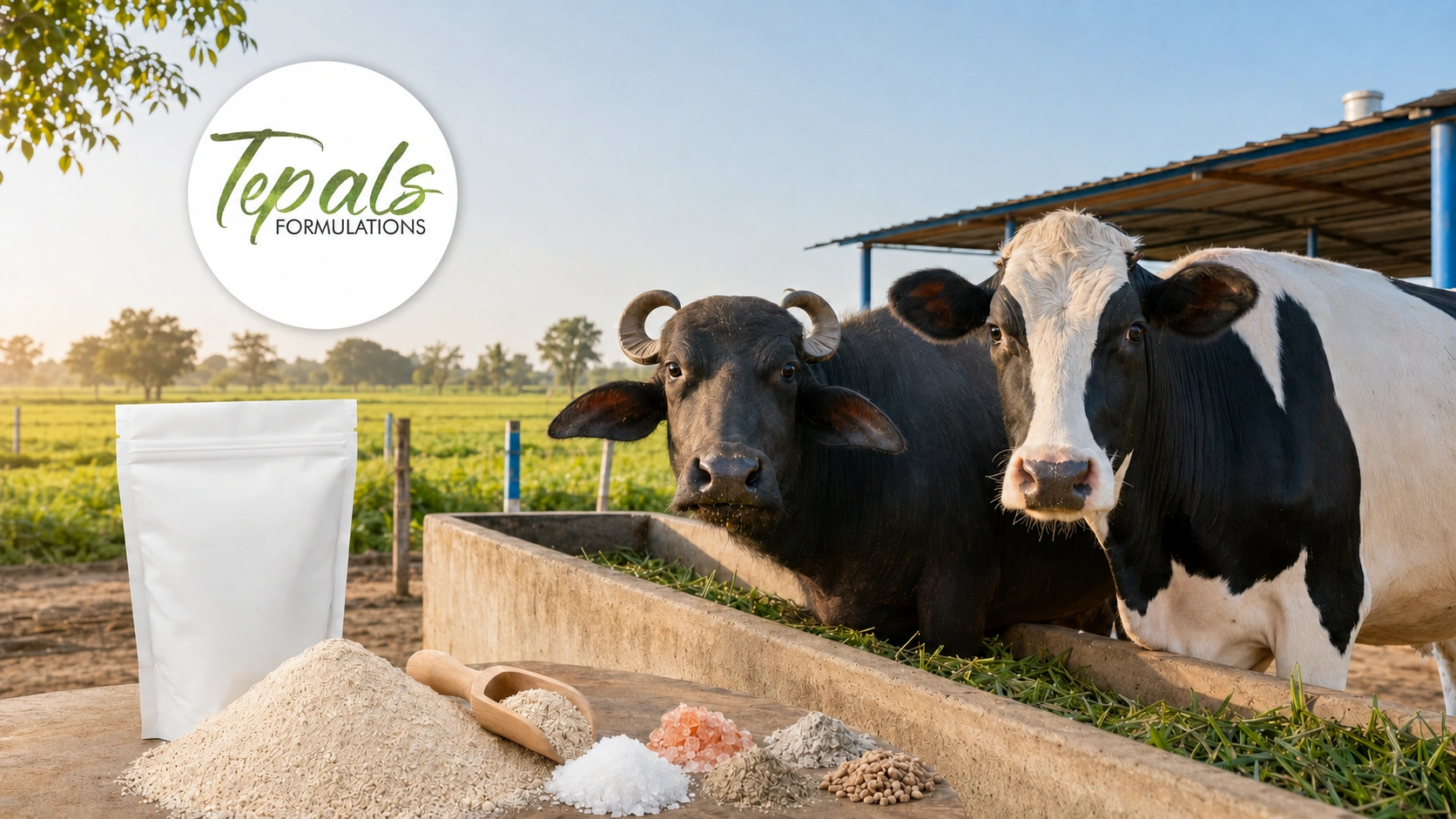
A mineral mixture is a feed supplement formulated to supply essential macro and trace minerals that may be missing from the regular diet of cows, buffaloes and other livestock. It is generally available as a free-flowing powder that can be mixed with concentrate, cattle feed or another suitable portion of the daily ration.
Green fodder, dry fodder and concentrate provide energy, protein and some minerals. However, their mineral value can change according to soil conditions, crop variety, maturity, storage and season. That is why an apparently full feeding trough does not always mean that the animal is receiving a completely balanced diet.
A suitable mineral mixture for cows or buffaloes can help correct these nutritional gaps. It supports normal body functions such as growth, bone development, reproduction, immunity and milk production. However, it is a nutritional supplement—not a medicine or an instant milk booster.
What Is a Mineral Mixture?
A mineral mixture is a carefully formulated combination of macro minerals and trace minerals intended for animal nutrition.
Fairly large amounts of macro minerals are required. Typical examples include:
- Calcium
- Phosphorus
- Magnesium
- Sodium
- Potassium
- Chloride
- Sulphur
You need smaller amounts of trace minerals, but they do important things. These may include:
- Zinc
- Copper
- Manganese
- Iron
- Iodine
- Cobalt
- Selenium
The precise composition is not the same in every product. It may differ based on the animal species, production stage, regional feed conditions and intended application. Some products may also contain vitamins, amino acids, yeast or other nutritional ingredients.
A mineral mixture should therefore be selected by reading its complete label rather than judging it only by price, colour or promotional claims.
Why Do Cows and Buffaloes Need Mineral Supplementation?
Animals get minerals from fodder, grains, water and soil-contaminated feed. Nevertheless, the amount actually supplied and absorbed may not always meet their requirements.
Common reasons for a mineral gap include:
- Poor mineral content in local soil and fodder
- Dependence on crop residues or low-quality roughage
- High milk production and increased nutritional demand
- Imbalanced calcium-to-phosphorus ratio
- Seasonal changes in fodder availability
- Limited variety in the daily ration
- Reduced feed intake during heat stress or illness
- Growth, pregnancy and early lactation requirements
- Interactions between different minerals in the ration
Mineral requirements also change through the animal’s life. A growing calf, a dry pregnant buffalo, and a high-yielding lactating cow should not automatically receive the same formulation or quantity.
Benefits of Mineral Mixture for Cows and Buffaloes
1. Filling Nutritional Gaps
The primary purpose of the mineral mixture powder is to supplement the minerals, which may be deficient in the basic ration. This makes the overall feeding programme more balanced.
It does not replace green fodder, dry fodder, concentrate, protein or clean drinking water.
2. Supports Normal Milk Production
Milk contains minerals, particularly calcium and phosphorus. Lactating cows and buffaloes consequently have greater nutritional demands than non-producing animals.
A balanced mineral supply supports normal metabolism and allows the animal to use the complete ration more effectively. However, the response depends on the animal’s genetics, health, stage of lactation and total diet. Mineral powder alone cannot compensate for inadequate energy or protein.
3. Supports Reproductive Performance
Minerals such as phosphorus, zinc, copper, manganese, iodine and selenium participate in reproductive and hormonal functions.
A deficiency may be one factor behind poor reproductive performance, but infertility can have several causes, including infection, uterine disorders, poor heat detection and inadequate body condition. Reproductive issues that persist need to be checked out by a professional, not blindly supplemented.
4. Supports Bone and Skeletal Development
Calcium and phosphorus are major structural components of bones. Magnesium and several trace minerals also participate in normal skeletal development.
Balanced mineral nutrition is particularly relevant for growing calves, heifers, pregnant animals, and high-producing dairy animals. Giving more calcium alone is not always the answer; the overall mineral balance matters.
5. Supports Immunity
Zinc, copper, and selenium contribute to normal immune and antioxidant functions. An adequately nourished animal may be better prepared to cope with routine environmental challenges.
A mineral mixture does not prevent or cure any infection. Vaccination, hygiene, deworming, clean water and prompt veterinary treatment are still essential.
6. Encourages Growth in Young Animals
Growing calves need adequate energy, protein, vitamins and minerals. Adequate intake of minerals enables normal development of bones, growth of tissues and activity of enzymes.
A calf mineral programme should be combined with colostrum management, calf starter, clean water, good housing and disease control.
7. Supports Skin, Coat and Hoof Condition
Zinc, copper, manganese and other nutrients participate in keratin and connective-tissue formation. Long-term nutritional inadequacy may sometimes be reflected in poor coat or hoof condition.
These signs are not specific to mineral deficiency. Parasites, infections and poor housing may produce similar problems.
8. Supports Feed Utilisation and Metabolism
Minerals act as components or activators of various enzymes. This means that they help the animal use nutrients involved in growth, maintenance and production.
The minerals do not digest the fodder directly, but the absence of them can upset normal metabolic processes.
Common Minerals and Their Nutritional Roles
| Mineral | General nutritional role |
|---|---|
| Calcium | Bones, teeth, muscle function and lactation |
| Phosphorus | Bones, energy metabolism and reproduction |
| Magnesium | Enzyme activity, nerves and muscles |
| Sodium and chloride | Fluid balance and nerve function |
| Potassium | Fluid balance and normal muscle activity |
| Zinc | Skin, hooves, immunity and enzyme function |
| Copper | Enzyme systems, connective tissue and pigmentation |
| Manganese | Bone development, metabolism and reproduction |
| Iodine | Thyroid hormone production |
| Cobalt | Supports rumen microbes involved in vitamin B12 production |
| Selenium | Antioxidant and immune functions |
| Iron | Formation of haemoglobin and oxygen transport |
More is not always better. Excessive intake of one mineral can sometimes reduce the absorption of another or cause toxicity. Selenium and copper, for example, require particularly careful formulation.
Mineral Mixture for Cow
A mineral mixture for cows should be selected according to the cow’s age, body weight, milk production, pregnancy status, ration and local fodder conditions.
Mineral Needs of Lactating Cows
A lactating cow needs a balanced supply of nutrients to support maintenance and milk production. Its requirements usually rise with milk yield, but this does not mean every high-yielding cow should receive an arbitrarily large dose.
Consider:
- Quantity and quality of green fodder
- Type of dry fodder
- Amount of concentrate feed
- Milk production
- Stage of lactation
- Body condition
- Existing fortified cattle feed
- Water quality
- Other supplements already being used
Mineral Needs of Dry and Pregnant Cows
The dry period is not a nutritional holiday. The ration should support maintenance, foetal growth and preparation for the next lactation.
Late-pregnancy mineral management requires particular care. Specialised products such as anionic mineral mixtures may be used in some close-up dry-cow programmes, but they should not be confused with ordinary mineral powder. Such programmes need ration-level planning and professional supervision.
Mineral Mixture for Buffalo
Buffaloes require the same essential mineral categories as cows, but their requirements and feeding management may differ according to body weight, milk yield, breed, stage of lactation and local feeding practices.
A mineral mixture for buffaloes may support:
- Normal milk production and milk composition
- Bone and muscle function
- Reproductive nutrition
- Growth of young stock
- Normal immunity
- Overall metabolic activity
Buffaloes are frequently maintained on straw, seasonal green fodder and home-mixed concentrate. If this ration is not properly balanced, a suitable mineral supplement may help fill the gap.
Farmers should avoid assuming that buffaloes always need a higher dose simply because they are larger. The correct quantity depends on the concentration and directions of the selected product.
Cow and Buffalo Mineral Requirements: Is There a Difference?
| Factor | Cow | Buffalo |
|---|---|---|
| Body weight | Varies by breed | Often higher in many dairy breeds |
| Milk composition | Generally lower milk fat than buffalo milk | Generally higher milk fat |
| Production level | Varies considerably | Varies considerably |
| Feeding system | Grazing, stall feeding or mixed | Commonly stall-fed or mixed |
| Supplement selection | Based on complete ration and production stage | Based on complete ration and production stage |
| Fixed universal dosage | Not recommended | Not recommended |
The species label alone is insufficient. The complete ration and product concentration are more useful when deciding the feeding quantity.
What Is Chelated Mineral Mixture?
In chelated mineral products, certain trace minerals are bound to an organic carrier. This form is designed to improve stability or availability under particular feeding conditions.
Chelated products may be useful in selected situations, but the word “chelated” does not automatically make every product better. Product quality still depends on:
- Type and amount of minerals
- Quality of raw materials
- Suitability for the intended animal
- Manufacturing consistency
- Mineral interactions
- Correct feeding rate
- Storage and packaging
A well-formulated product should provide transparent composition and feeding directions instead of relying solely on the chelated claim.
Mineral Mixture Powder vs Mineral Block
| Point | Mineral mixture powder | Mineral block |
|---|---|---|
| Feeding method | Mixed into measured feed | Offered for licking |
| Intake control | Easier when individually mixed | Intake can vary between animals |
| Suitability | Stall-fed and measured feeding systems | Grazing or group-management situations |
| Monitoring | Quantity can be recorded | Individual intake can be difficult to measure |
| Moisture protection | Needs dry, sealed storage | Still requires weather protection |
For many dairy farms, powder mixed into a known amount of concentrate offers more consistent control. Free-choice products may be practical, but intake should be monitored because cattle do not always consume minerals precisely according to their individual requirements.
How Much Mineral Mixture Should Be Given?
There is no single dosage suitable for every mineral mixture powder.
As a general reference, the National Dairy Development Board lists approximately:
- Young calves: 20–25 grams daily
- Heifers and dry animals: around 50 grams daily
- Milking animals: around 100–200 grams daily, depending on milk production
These figures are general feeding recommendations and must not override the selected product’s label. Concentrated formulations may have much lower feeding rates. Some commercial products, for example, recommend approximately 30–50 grams for large animals.
This difference shows why farmers should not copy a dosage from another brand or an online video. Follow:
- The manufacturer’s label
- The animal’s total ration
- A veterinarian or qualified animal nutrition professional’s recommendation
The NDDB feeding guidance is a useful reference, but it should be applied within a complete feeding programme.
How to Feed Mineral Mixture Powder
The most practical method is to mix the measured quantity thoroughly into concentrate or another feed portion the animal will consume completely.
Recommended Feeding Process
- Check the product label and expiry date.
- Dispense the recommended amount.
- Mix well with a small amount of feed.
- Make sure that the animal gets that much to eat.
- Introduce the product gradually if the taste is unfamiliar.
- Feed at the same times every day.
- Provide unrestricted access to clean drinking water.
- Review other fortified feeds and supplements to prevent duplication.
Do not put in the manger an unmeasured amount of loose powder. Uneven intake means some animals will get too little, while others will consume too much.
Best Time to Give Mineral Mixture
Consistency is more important than a particular clock time. Mineral powder can usually be mixed with the morning or evening concentrate, depending on farm routine.
If the daily quantity is relatively high, the label or nutrition professional may advise dividing it between two feedings. Do not mix the product into feed that the animal commonly leaves unfinished.
How Long Does It Take to See Results?
There is no honest universal timeline.
If a genuine dietary shortage is corrected, improvements may become noticeable over time. However, milk production, coat condition, fertility, and growth are influenced by many factors.
Before deciding that a product is ineffective, review:
- Whether the animal consumes the complete dose
- Whether the ration supplies enough energy and protein
- Fodder quality
- Parasite control
- Heat stress
- Disease or mastitis
- Stage of lactation
- Water availability
- Product storage
Mineral supplementation should be considered as part of the overall feeding programme rather than a quick treatment.
Signs That May Suggest a Nutritional Problem
Possible warning signs may include:
- Poor growth
- Weak body condition
- Rough coat
- Reduced appetite
- Unusual licking or eating of soil
- Poor reproductive performance
- Weak bones or lameness
- Reduced production
- General unthriftiness
None of these signs proves a mineral deficiency. They can also result from infectious disease, parasites, poor-quality feed, metabolic disorders or other health problems. Arrange a veterinary evaluation when signs persist.
How to Choose the Best Mineral Mixture
See the Complete Composition
The label should list the minerals supplied and their concentration. Avoid choosing a powder based only on colour or flavour.
Select the Right Animal Category
A general cattle mineral, calf mineral, dairy mineral, and pre-calving mineral may have different purposes. Match the formulation to the animal and production stage.
Look for Clear Feeding Instructions
A good label should tell you how much to feed and how to feed it.
Quality Check for Manufacturing and Packaging
Select densely packed products from a responsible veterinary manufacturer. The pouch or container is intended to protect the powder from contamination and moisture.
Avoid Unrealistic Claims
Be cautious of claims promising guaranteed milk increases, instant fertility correction, or treatment of every livestock problem.
Evaluate the Complete Ration
If the animal already receives fortified compound feed, adding several separate supplements may duplicate certain nutrients. Ration review is more useful than combining products at random.
Seek Professional Advice
For high-yielding herds, repeated fertility problems, or pre-calving nutrition, professional ration formulation may save more money than trial-and-error supplementation.
Mineral Mixture Manufacturer and Bulk Supply
Veterinary businesses, cattle feed dealers, and livestock product distributors may require mineral mixture powder under bulk or private-label arrangements.
When comparing manufacturers, consider:
- Feasibility of composition
- Quality of raw material
- Batch-to-batch consistency
- Quality Control Process
- Packaging Choices
- Min. order quantity
- Branding and labelling support
- Capacity of production
- Capability to dispatch
- Product classification and documents
Tepals Formulations may be considered by businesses for veterinary feed-supplement manufacturing, bulk supply or private-label support. Buyers should confirm the required composition, pack size, minimum order, allowed claims and commercial terms just before placing an order.
FAQ’s
1. What is a mineral mix for cattle?
It is a feed supplement containing macro and trace minerals which helps to balance the diet of cows, buffaloes and other livestock.
2. What are the benefits of mineral mixture for cows?
When incorporated in a balanced ration, it contributes to normal bone health, metabolism, immunity, reproduction, growth and milk production.
3. Can mineral mixture increase milk production?
It may support production when a mineral shortage is limiting performance. It cannot guarantee an increase or compensate for insufficient energy, protein, water, or poor health.
4. How much mineral mixture should a cow receive daily?
The correct quantity depends on the formulation, ration and production stage. Follow the product label or professional advice rather than applying one universal dosage.
5. Is mineral mixture good for buffaloes?
Yes. You can use mineral mixture for dairy cattle products. The label should indicate the type and the amount of feed.
6. Can mineral powder be added into cattle feed?
Yeah. The standard way is to mix the measured amount evenly with some feed to be completely eaten by the animal.
7. Is a chelated mineral mixture better?
Chelated minerals may offer advantages in selected conditions, but quality depends on the complete formulation, mineral level, raw materials and correct use.
8. Mineral Mixture and Calcium Supplement Can Be Given Together?
They may sometimes be used together, but their composition should be checked to avoid superfluous duplication or imbalance. Go see a nutritionist or a vet.
9. Can mineral mixture cure infertility?
No. Nutrition is only one factor affecting fertility. Infection, uterine disorders, heat detection and body condition may also be involved.
10. Can mineral mixture be given throughout the year?
Year-round supplementation may be appropriate in some feeding programmes, but the formulation and quantity should be periodically reviewed as fodder and production stage change.
Conclusion
A mineral mixture for cows and buffaloes can be a valuable part of dairy nutrition when it is selected and fed correctly. It helps fill mineral gaps and supports normal growth, bones, metabolism, immunity, reproduction and milk production.
The best results come from treating mineral supplementation as one part of a complete programme involving balanced fodder, adequate concentrate, clean water, disease prevention and regular professional guidance.