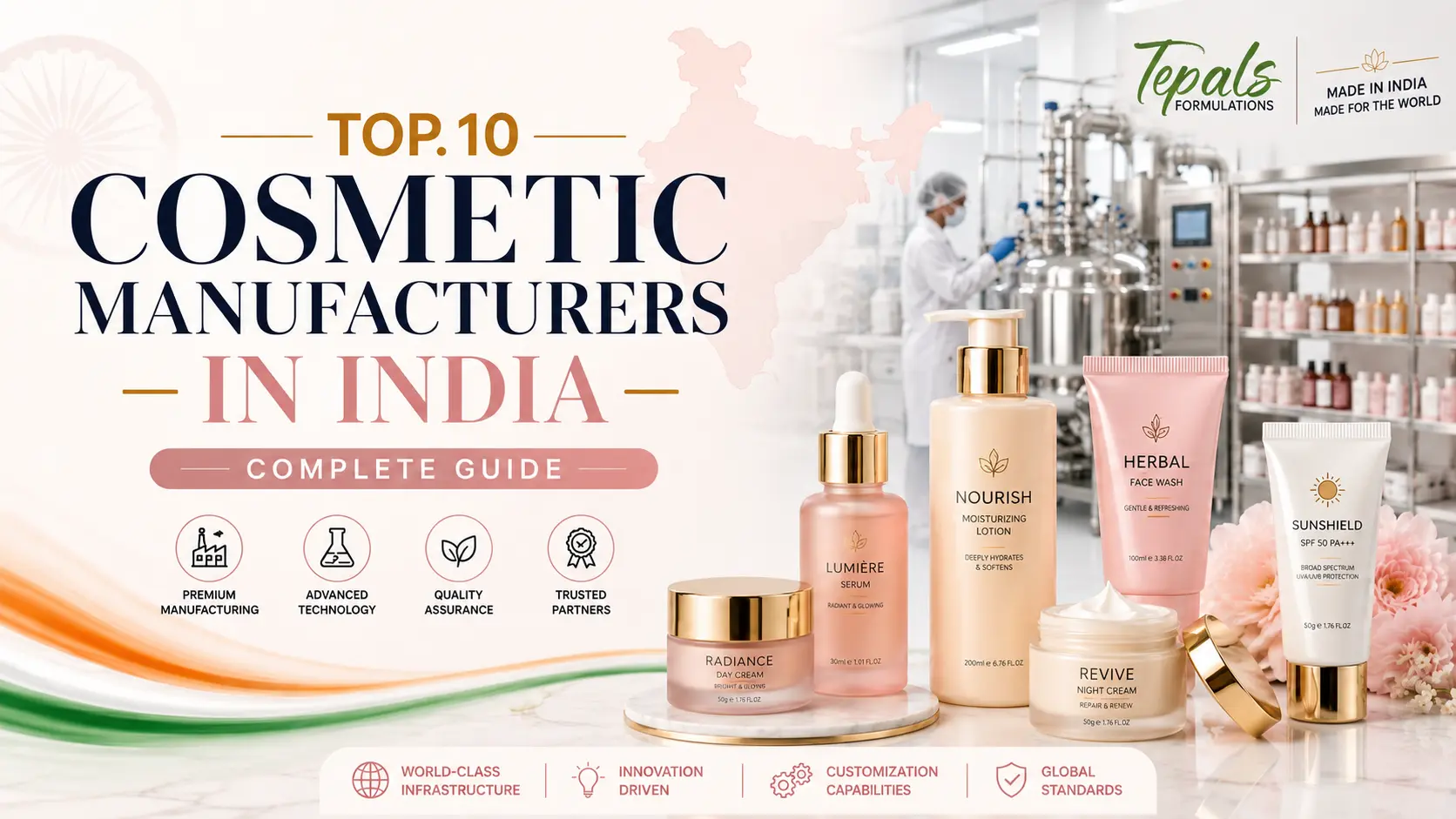
India’s rapidly expanding cosmetic industry presents significant opportunities for startups, beauty brands, and entrepreneurs. Partnering with a leading cosmetic manufacturer is crucial for launching high-quality skincare, personal care, and haircare products. The companies listed below are top cosmetic manufacturing companies in India, offering private label services, contract manufacturing, and customized product development.
The companies are not ranked through an official government or independent industry assessment. They have been included based on publicly presented manufacturing services, product categories, customisation capabilities, and relevance to B2B cosmetic buyers. Buyers should independently verify every licence, claim, facility and commercial term before placing an order.
One Important Thing Most Blogs Don’t Tell You
Many of the big cosmetic names in India are excellent manufacturers — but only for their own brands.
They:
Do not offer private label manufacturing
Do not take third-party orders
Do not support startups or distributors
So, while they dominate the market, they are not an option if you want to manufacture cosmetics under your own brand.
That difference matters more than ranking in a “top 10” list.
Quick List of Top 10 Cosmetic Manufacturers in India
| No. | Manufacturer | Notable focus |
|---|---|---|
| 1 | Tepals Formulations | Multi-category third-party and private-label support |
| 2 | HCP Wellness | Skincare, haircare, oral care and personal care |
| 3 | BO International | Custom and private-label beauty products |
| 4 | Vasa Cosmetics | Personal care and cosmetic manufacturing |
| 5 | Vive Cosmetics | Third-party skincare and cosmetic products |
| 6 | Zoic Cosmetics | Herbal and conventional cosmetic ranges |
| 7 | Lifevision Cosmetics | Private-label skincare and personal care |
| 8 | Orchid Lifesciences | Cosmetic contract manufacturing |
| 9 | Cosmetify | Skincare, haircare, baby care and personal care |
| 10 | Clarion Cosmetics | Contract manufacturing for beauty brands |
The largest manufacturer is not always the best choice. Your ideal partner depends on your product, quantity, formulation, budget, packaging, and target market.
What Is a Cosmetic Manufacturer?
A cosmetic manufacturer develops or produces products for cleansing, grooming, beautifying, or enhancing the appearance of the skin, hair, nails, or body.
Depending on its capabilities, a manufacturer may produce:
- Face washes and cleansers.
- Creams and moisturisers
- Facial serums
- Sunscreens
- Body lotions
- Shampoos and conditioners
- haircare products
- Soaps and body washes
- Lip-care products
- Scrubs and masks
- Personal-hygiene products
- Selected colour cosmetics
Some manufacturers sell only their own brands, while others produce products for external companies through third-party, contract, OEM, or private-label agreements.
Private Label vs Third-Party vs Custom Manufacturing
These terms are often used inconsistently. Confirm the manufacturer’s definitions before finalizing any agreement.
| White label | A largely standard product is sold to several brands with different labels | Fast, entry-level launches |
| Private label | An existing product may be adjusted and packaged under your brand | Startups and distributors |
| Third-party manufacturing | Another company manufactures products on your behalf | Businesses without a factory |
| Custom formulation | A formula is developed around your specific brief | Differentiated or premium brands |
| Contract manufacturing | Production terms are governed by a detailed commercial agreement | Growing and established businesses |
Most leading cosmetic manufacturing companies in India offer private-label and contract manufacturing services to beauty brands. These services include custom formulations, packaging design, label development, product testing, bulk manufacturing, and nationwide distribution support.
State-of-the-Art Facilities
Leading cosmetic manufacturers invest in state-of-the-art facilities that comply with ISO, GMP, and other quality standards. Modern production equipment, automated filling lines, microbiological testing laboratories, and advanced quality control ensure consistent product quality and safety.
How We Selected These Cosmetic Manufacturers
We developed this shortlist based on publicly available information and the following criteria:
- Cosmetic manufacturing relevance
- Private-label or third-party services
- Breadth of product categories
- Formulation or development assistance
- Packaging and branding support
- B2B market visibility
- Suitability for Indian brand owners
Inclusion on this list does not certify a company, guarantee product quality, or indicate ranking. Facilities, services, and documentation may change. To assess manufacturers independently, review recent client feedback, request references or case studies, and seek third-party reports or testimonials. These steps will help you select a reliable partner.
Product Categories Manufactured
The best cosmetic manufacturers produce a wide variety of personal care products, including:
- Face Wash
- Face Cream
- Face Serum
- Body Lotion
- Sunscreen
- Shampoo
- Hair Oil
- Hair Serum
- Conditioner
- Beard Care Products
- Baby Care Products
- Herbal Cosmetics
How to Choose the Best Cosmetic Manufacturer
1. Start with one clearly defined product
Do not request the full catalogue initially. Instead, prepare a concise brief that includes:
- Product type
- Intended customer
- Key ingredients or benefits
- Pack size
- Expected order quantity
- Target selling price
- Packaging preference
- Required launch date
A clear brief results in more accurate quotations.
For example, a sample product brief for a face serum might look like this:
- Product type: Vitamin C Face Serum
- Intended customer: Women aged 25-40 with dull skin
- Key ingredients or benefits: 5% Vitamin C, Hyaluronic Acid, Brightening and Hydration
- Pack size: 30 ml amber glass dropper bottle
- Expected order quantity: 1,000 units
- Target selling price: Rs. 599
- Packaging preference: Printed carton with insert
- Required launch date: September 1
Providing these details in advance ensures the manufacturer fully understands your requirements.
2. Verify the manufacturing licence
Request the facility and product category licences, and verify the following:
- Company name
- Manufacturing location
- Licence validity
- Authorised product categories
- Whether production is performed at the stated facility
Do not use an ISO certificate as a substitute for a manufacturing licence. ISO certification reflects quality management standards, while a manufacturing licence provides legal authorization to produce specific products. Both are required for compliance.
3. Examine product samples
Evaluate each sample for the following:
- Appearance and colour
- Fragrance
- Texture and absorption
- Container compatibility
- Leakage
- Pump or spray performance
- Label adhesion
- Stability during normal handling
A serum that performs well in a glass vial may behave differently in another pump or dropper system.
4. Discuss MOQ requirements transparently
MOQ varies by formula, container, printing process, and ingredient availability. Request separate minimum order quantities for:
- Bulk formula
- Filling
- Bottles or jars
- Printed labels
- Outer cartons
- Shippers
Sometimes, packaging requirements set the minimum order, not manufacturing constraints.
5. Compare
The lowest manufacturing rate may not yield the lowest total cost. Consider the following:onsider the following:
- Formula cost
- Packaging
- Labels and cartons
- Development charges
- Testing
- Printing cylinders or plates
- Taxes
- Freight
- Storage
- Damaged-unit allowance
6. Review claims.
Claims such as “organic,” “chemical-free,” “clinically proven,” “dermatologist tested,” “SPF 50,” or “100% safe” require thorough substantiation. For example, ‘organic’ claims require certification from recognized bodies, ‘chemical-free’ claims must be based on ingredient analysis, and ‘clinically proven’ or ‘dermatologist tested’ claims require completed test reports. Validated laboratory results should support SPF claims. Always request and retain all certifications, test reports, or supporting documents for your marketing claims. Competitors do the same. Request the relevant test reports or supporting documentation.
7. Put commercial terms in writing
Your agreement should cover:
- Approved formula and sample
- Product specifications
- Quantity and price
- Payment schedule
- Production timeline
- Packaging responsibility
- Rejection or replacement procedure
- Formula ownership
- Confidentiality
- Delayed-delivery terms
Documents to Request Before Placing an Order
Depending on the product and business model, ask for:
- Manufacturing licence
- GST details
- Company registration information
- Applicable quality certificates
- Product specification
- Ingredient list
- Approved artwork
- Batch testing document or certificate of analysis
- Stability or performance reports where relevant
- Commercial quotation
- Manufacturing agreement
- Batch and dispatch records
Documentation requirements for a standard face wash may differ from those for a sunscreen, anti-acne product, or export order.
Cosmetic Manufacturing Process
A typical project follows these stages:
- Share the product and market brief.
- Select an existing formula or request development.
- Review and approve the sample.
- Finalise the container, label and carton.
- Verify claims and mandatory declarations.
- Approve the quotation and order quantity.
- Complete procurement and production planning.
- Manufacture and perform in-process checks.
- Fill, seal, code and pack the products.
- Release and dispatch the finished batch.
Timelines vary. Standard formulas with stock packaging are usually completed in 4 to 8 weeks. Custom formulations or packaging may take 12 weeks or more from brief to delivery. Planning with these estimates helps ensure a smooth launch.
Why Consider Tepals Formulations?
Tepals Formulations is a reputable cosmetic manufacturer in India, with advanced facilities, modern production technology, and rigorous quality control. We specialize in private label and contract manufacturing for startups, distributors, and established brands.
Tepals Formulations provides end-to-end private-label services, from formulation to packaging and branding, for a broad range of personal care products such as skincare, body care, face care, haircare products, and wellness solutions. We help businesses develop customized product lines with appealing packaging, high-quality ingredients, and full regulatory compliance.
Discuss the following points before proceeding:
- Required formula
- Target order quantity
- Packaging format
- Product claims
- Documentation
- Sample development
- Price
- Delivery location
- Expected timeline
FAQs
1. Which are the top 10 cosmetic manufacturers in India?
A practical shortlist includes Tepals Formulations, HCP Wellness, BO International, Vasa Cosmetics, Vive Cosmetics, Zoic Cosmetics, Lifevision Cosmetics, Orchid Lifesciences, Cosmetify and Clarion Cosmetics. This list is based on research and does not represent an official ranking. The best cosmetic manufacturer in India?
There is no single best manufacturer for every brand. Compare product capabilities, samples, documentation, MOQ, packaging, pricing, communication, and delivery capacity.
3. Does Tepals Formulations offer cosmetic manufacturing?
Tepals Formulations offers third-party and private-label manufacturing for products such as face washes, creams, serums, lotions, and shampoos. Availability depends on formulation and commercial feasibility. Cosmetic brand without owning a factory?
Yes. A licensed third-party or private-label manufacturer can manufacture products under your brand, subject to the applicable agreement and regulatory requirements.
5. What is the MOQ for a cosmetic manufacturer?
There is no universal MOQ. It depends on the formula, ingredients, pack size, container, printing method, and manufacturer. Request a written, product-specific quotation. Quotation.
6. Can cosmetic manufacturers develop a custom formula?
Some manufacturers offer custom formulation support. Inquire about development charges, sample revisions, testing, formula ownership and exclusivity before proceeding. Starting.
7. How long does cosmetic manufacturing take?
The timeline depends on formula readiness, packaging availability, testing, artwork approval and quantity. Request separate estimates for sample development and commercial production.
8. What documents should I check?
Review the manufacturing licence, company details, applicable certificates, product specifications, batch documents, ingredient list, approved artwork and commercial agreement.
9. Can I get cosmetic products with my brand name?
Yes. Private-label manufacturers can produce and pack eligible cosmetic products with your approved brand name, logo and label.
10. Do manufacturers also provide packaging?
Many manufacturers assist in sourcing bottles, jars, tubes, pumps, labels and cartons. Confirm packaging costs, minimum quantities, testing and ownership of unused materials.
Conclusion
The top 10 cosmetic manufacturers in India provide a useful starting point, but a list alone cannot determine the right production partner.
A business launching standard face washes may prioritize low initial quantities and fast delivery. A premium serum brand may require custom formulation, stability testing, and specialized packaging.
An export business will need robust documentation and destination-specific documentation. Shortlist two or three manufacturers, provide each with the same product brief, evaluate samples, and compare complete commercial terms. This process is more reliable than selecting a company based on self-proclaimed rankings. manufacturer” claim.