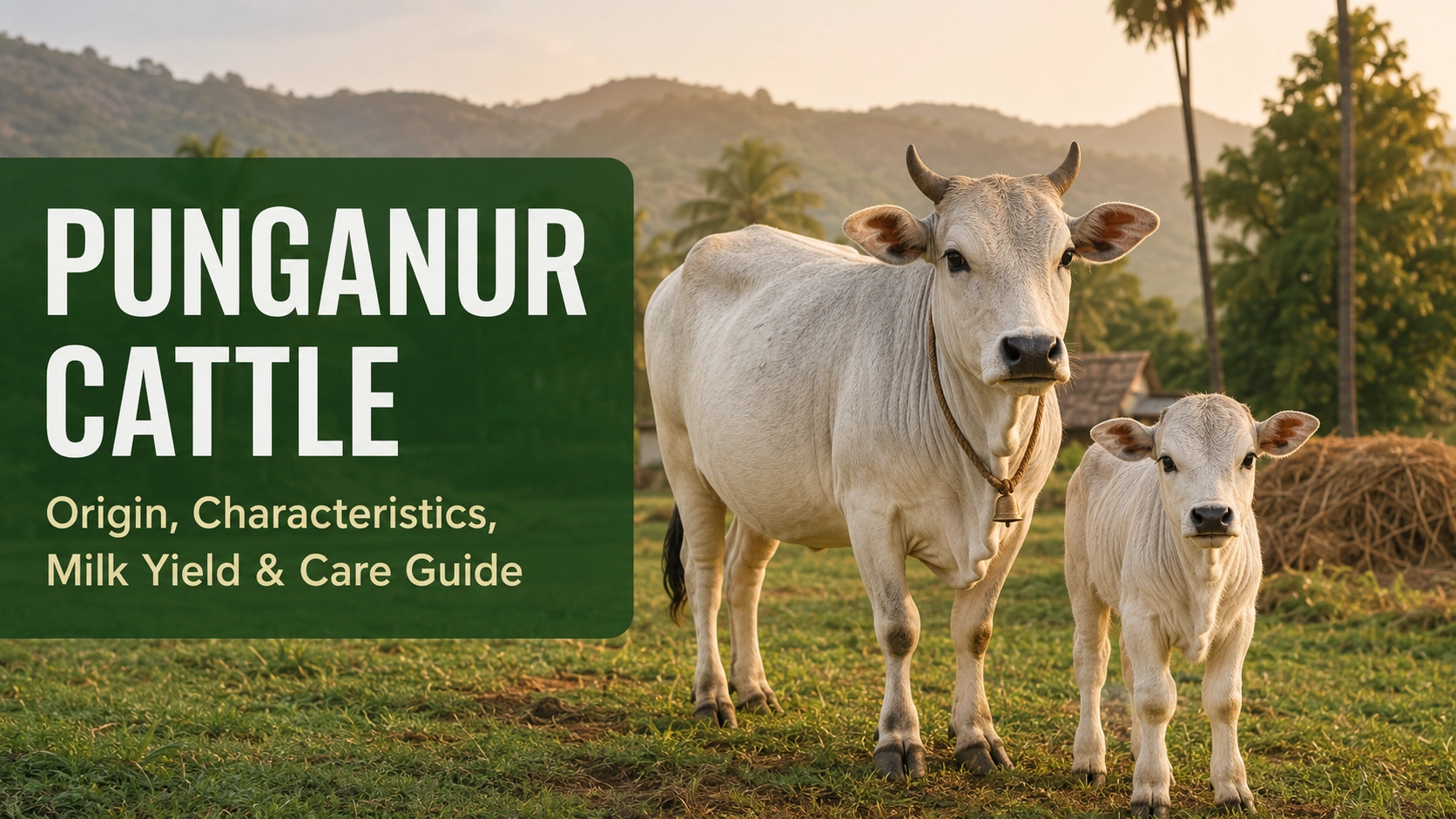
Punganur cattle are a compact indigenous zebu breed originating in Andhra Pradesh. They are recognized for their short stature, adaptability to tropical conditions, and relatively modest maintenance needs. Their distinctive appearance has also made them one of India’s most discussed native cattle breeds.
The breed is often introduced online as the “smallest cow in the world.” A more accurate description is that Punganur is among the smallest recognized zebu or humped cattle breeds. Fully grown animals remain much smaller than commercial dairy breeds, but their exact height and body weight vary according to sex, bloodline, nutrition and management.
Interest in the Punganur cow has increased considerably. Farmers, indigenous-breed enthusiasts, gaushalas and small landholders are exploring the breed. However, its popularity has also encouraged exaggerated claims and the sale of crossbred or unrelated small cattle under the Punganur name.
This guide explains what buyers and farmers should realistically know before keeping or purchasing Punganur cattle.
What Are Punganur Cattle?
Punganur cattle are an indigenous Indian zebu breed native to the Chittoor region of Andhra Pradesh. The traditional breeding tract is associated particularly with Punganur and areas around Madanapalle, Palamaner, and Vayalpad.
These cattle are known for:
- Compact body structure
- Short legs
- Small crescent-shaped horns
- Broad forehead
- Noticeable but relatively small hump
- Heat tolerance
- Ability to adapt to local feeding conditions
- Milk production despite their small body size
The breed has traditionally been used for milk as well as limited draught work. Today, its genetic and cultural importance may be greater than its commercial milk-producing value.
A recent ICAR publication describes Punganur as a registered Indian cattle breed native to Chittoor and highlights its short size, tropical adaptability, heat tolerance and low maintenance requirements.
Punganur Cattle at a Glance
| Feature | General description |
|---|---|
| Breed type | Indigenous dwarf zebu cattle |
| Native region | Chittoor region, Andhra Pradesh |
| Common colours | White, light grey, red, brown and mixed shades |
| Horns | Short and generally crescent-shaped |
| Main uses | Milk, breed conservation and limited farm work |
| Average female height | Approximately 97 cm in recorded international breed data |
| Average male height | Approximately 107 cm |
| Average female weight | Around 170 kg |
| Average male weight | Around 240 kg |
| Milk production | Often around 2 litres per day on recorded averages; individual yield varies |
| Climate suitability | Warm and tropical conditions |
| Main concern | Breed purity and long-term conservation |
These figures should be treated as breed averages, not purchase guarantees. Small private herds may record very different results.
Origin and History of the Punganur Cow
The breed takes its name from Punganur, a town historically associated with the breed in present-day Andhra Pradesh.
Local rulers and livestock keepers are believed to have played a role in selecting smaller cattle that could survive under the region’s available resources. Over generations, a compact population developed with recognizable physical and adaptive traits.
Punganur cattle were especially useful where:
- Grazing land was limited
- Summer temperatures were high
- Fodder quality changed seasonally
- Families preferred animals with manageable feed requirements
- Large dairy cattle were difficult to maintain
Traditional breeding gradually declined as farmers moved towards higher-yielding dairy breeds and crossbred animals. Both the utilization of native bulls and the unplanned crossbreeding of Punganur cattle had contributed to a decrease in the availability of genetically representative Punganur cattle.
Physical Characteristics of Punganur Cattle
Punganur animals should be evaluated by their complete breed type. Height alone is not sufficient to prove that an animal is pure.
Compact body
The animal generally has a small, closely built frame. Its body is deeper and more proportionate than that of an underdeveloped calf or a nutritionally stunted animal.
Short legs
Short limbs are one of its most noticeable features. The legs should still appear sound, balanced, and capable of supporting normal movement.
Forehead and face
The breed usually has a broad forehead and a relatively short face. The eyes often appear alert and prominent.
Horns
Horns are normally short and may curve outward or upward in a crescent-like form. Horn shape varies with age and the individual animal.
Hump and dewlap
As a zebu breed, Punganur cattle have a hump. Bulls normally have a more prominent hump than cows. The dewlap is present but should remain proportionate to the small frame.
Coat colour
Common coat colours include:
- White
- Light grey
- Dark grey
- Brown
- Red
- Mixed or patched shades
Colour alone cannot confirm breed purity.
Height and weight
International breed data reports approximate averages of 97 cm and 170 kg for females and 107 cm and 240 kg for males. Some online pages use much lower figures, occasionally describing exceptionally small individual animals as normal breed standards. Buyers should therefore distinguish between a healthy adult animal and an unusually small specimen.
Punganur Cow Milk Yield
Milk yield is one of the most misunderstood aspects of Punganur cattle.
Documented breed-level data indicates an average lactation yield of around 546 kg over approximately 263 days, equivalent to roughly 2.07 kg per day. Average recorded milk fat is about 5%, although milk composition and production can vary. Punganur breed profile and DAD-IS references
Many commercial and general-information pages quote three to five litres per day and fat levels approaching 8%. Certain well-managed cows may produce more than the breed average, particularly during peak lactation. That does not mean every animal will provide this yield.
Production depends on:
- Genetics and breed purity
- Lactation number
- Stage of lactation
- Age and health
- Quality of fodder
- Concentrate supplementation
- Water intake
- Milking routine
- Calving history
- Disease and parasite control
A seller’s milk-yield claim should ideally be verified through supervised milking over several days.
Is Punganur Cow Milk Always A2 Milk?
Indigenous zebu cattle are commonly associated with the A2 form of beta-casein. However, breed identity alone should not be used as a laboratory certificate for an individual animal.
Milk protein type is genetically determined. If a buyer plans to market milk specifically as A2, the responsible approach is to arrange genotype or milk testing through a suitable laboratory.
Similarly, claims that Punganur milk cures diseases or contains medically beneficial quantities of gold should not be used in marketing without dependable scientific evidence.
Milk can be a nutritious food, but its value depends on composition, hygiene, handling and the consumer’s dietary needs. It is not a replacement for medical treatment.
Punganur Cattle Versus Commercial Dairy Cows
| Factor | Punganur cattle | Commercial dairy breeds |
|---|
| Body size | Very small | Medium to large |
| Feed requirement | Relatively low | Usually higher |
| Typical milk volume | Low to moderate | Moderate to very high |
| Space requirement | Lower | Higher |
| Tropical adaptability | Generally good | Depends on breed |
| Primary value | Adaptability and conservation | Commercial milk output |
| Purchase availability | Limited | Widely available |
| Breed-verification risk | High | Usually lower |
Punganur cattle should not be purchased as miniature substitutes for high-yielding dairy cows. They are important for their indigenous genetics, adaptability, manageable size, and conservation importance.
Advantages of Raising Punganur Cattle
Lower space requirement
Their compact size may make housing easier for small farms, institutions, and households with limited land. Nevertheless, animals still require adequate exercise, drainage and ventilation.
Relatively manageable feeding
A smaller animal generally consumes less total dry matter than a large dairy cow. This does not mean it can remain healthy on kitchen leftovers or poor-quality straw alone.
Adaptation to warmer conditions
Punganur cattle developed in a tropical environment. Native adaptability can be useful where heat, variable fodder and seasonal stress affect imported or high-producing animals.
Easier physical handling
Their small frame can make daily management easier. Safe handling facilities are still necessary because even a small adult bull can cause serious injury.
Conservation value
Maintaining verified, unrelated breeding animals helps preserve an important Indian genetic resource.
Suitability for integrated farms
Dung and urine can support composting and manure management. Small farms may integrate cattle with fodder production, horticulture, or natural-farming systems.
Limitations Buyers Should Understand
Punganur cattle also have important limitations:
- Milk yield is lower than specialized dairy breeds.
- Pure or representative breeding stock can be difficult to verify.
- Purchase prices may be driven by rarity rather than farm productivity.
- Unrelated bulls or semen may not be easily available.
- Small body size does not eliminate veterinary costs.
- Inbreeding could be increased by poor genetic planning in breeding.
- Stress and compliance issues can be caused by long-distance transportation.
For a completely volume-based dairy business, breeds selected for higher production may be more cost-effective. Punganur cattle are often more relevant for conservation farms, specialized native-cattle projects and low-input systems.
Feeding Punganur Cattle
Low maintenance should never be confused with no maintenance. A suitable ration must meet the animal’s requirements for maintenance, growth, pregnancy and milk production.
Green fodder
Depending on local availability, farmers may use:
- Hybrid Napier
- Maize fodder
- Sorghum
- Cowpea
- Berseem in suitable seasons
- Locally available grasses
Sudden feeding of large quantities of very young sorghum should be avoided because of potential toxicity risks. A local veterinarian or livestock officer can advise on safe harvesting stages.
Dry fodder
Clean, mould-free dry fodder helps provide fibre. Paddy straw, wheat straw or suitable crop residues may be used, but should not be the animal’s only nutritional source.
Concentrate feed
Lactating, pregnant and growing animals may require concentrate supplementation. The quantity should be based on body weight, milk production and fodder quality—not on a generic dose intended for a much larger cow.
Mineral mixture
An appropriate cattle mineral mixture can help address mineral gaps in the ration. Select it according to regional needs and feed it at the recommended level.
Clean water
Fresh drinking water must remain available. Requirements rise during hot weather, lactation, and dry-feed consumption.
Salt
Provide salt according to professional feeding recommendations. Avoid random over-supplementation.
Housing and Daily Care
A shed for Punganur cattle in practice should be:
- Protection against the strong sun and rain.
- Adequate cross-ventilation
- A dry, non-slippery floor
- Good drainage of urine and waste water
- Keep clean feeding and watering areas separate
- Ample space to move about freely
- A secure maternity or calving area
- Safeguard from stray dogs and wild animals
Regular removal of dung and damp bedding is necessary. Poor drainage increases flies, hoof problems, skin infections and mastitis risk.
Even though the animal is small, permanent tethering in a confined space is not recommended. Exercise supports joint health, natural behaviour and overall fitness.
Punganur Cow Price in India
There is no fixed price for a Punganur cow. Online figures can vary greatly, and advertised prices are not the same as verified transaction values.
The price may depend on:
- Age
- Sex
- Pregnant or not.
- Lactation period
- Real milk yield
- registration papers
- Authenticity breeds
- Health record and vaccination
- Where
- freight charge
- Availability of pure-bred stock
- Seller reputation
Social-media popularity and rarity can increase prices. High asking price does not mean purity.
Punganur Cattle Questions and Answers
Q1. What is Punganur Cow Breed?
Punganur cattle are a small indigenous breed of zebu, found in Chittoor district of Andhra Pradesh. They are known for small size, tropical adaptability, and relatively low maintenance needs.
2. Is Punganur the smallest cow breed in the world?
It is more accurate to describe Punganur as one of the smallest recognized humped or zebu cattle breeds. Individual height varies, and not every viral miniature cow is a pure Punganur animal.
3. How much milk does a Punganur cow give?
Recorded breed-level data show an average of about two kilograms per day across lactation. The yield should be checked for the particular animal, but some cows may give more under good management.
4. What is the height of a Punganur cow?
Reported international breed data gives an average height of approximately 97 cm for females and 107 cm for males. Bloodline, sex, age and nutrition can affect measurements.
5. What is the price of a Punganur cow?
There is no standard price. Age, pedigree, health, pregnancy, milk yield, location and authenticity influence the amount. Buyers should look at the animal before paying a premium for rarity.
6. Is Punganur cow milk A2?
The breed is commonly associated with A2 beta-casein, but an individual animal’s status should be confirmed through suitable testing if the milk will be marketed specifically as A2.
7. How can I identify a pure Punganur cow?
General breed type, adult measurements, horns, body proportions, pedigree records, and source history. A qualified breed expert or veterinary institution should evaluate Expensive breeding animals.
8. What do Punganur Cattle eat? Punganur Cattle are herbivores.
They require a balanced combination of clean green fodder, dry fodder, adequate concentrate, mineral supplementation, salt, and fresh water. Quantities should be according to body weight and production stage.
9. Are Punganur cattle suitable for commercial dairy farming?
Milk production is not great, so not the first choice for high-volume dairy farming. They may be suitable for small farms, conservation projects and specialized indigenous-cattle programmes.
10. Why are Punganur cattle important?
Small, tropical-adapted, and a valuable genetic resource. Protecting representative breeding populations supports livestock biodiversity.
Conclusion
Punganur cattle are a distinctive indigenous breed with a small frame, strong regional identity and valuable adaptive traits. They can suit low-input farms and conservation programmes, but they should not be evaluated using milk volume alone.
Anyone planning to purchase a Punganur cow should verify its age, pedigree, health, milk production and source. A healthy, functional and traceable animal is more valuable for conservation than one selected only because it appears unusually small.