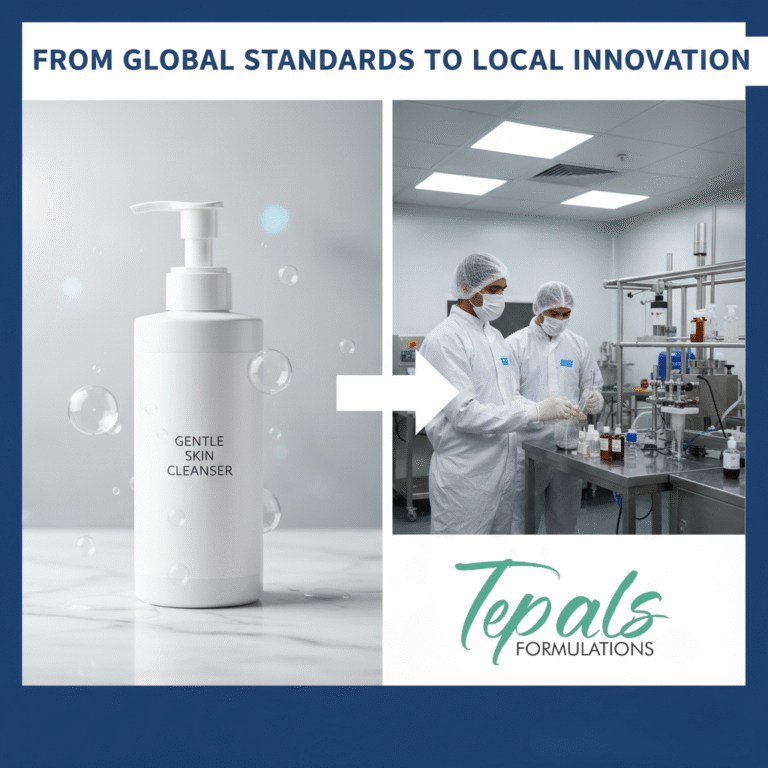

Cosmetic Manufacturing Process in India – What Actually Happens Behind the Scenes
If you’re searching for cosmetic manufacturing process India, chances are you’re not a student or a beginner.
You’re probably someone who is:
-
Planning to launch a cosmetic brand
-
Talking to manufacturers already
-
Comparing two or three options
-
Trying to understand who is genuine and who is just selling
Most blogs explain the process in a very textbook way.
But real manufacturing in India doesn’t work like that.
So let’s talk practically, the way it actually happens when brands work with a manufacturing unit.
Manufacturing doesn’t start with machines, it starts with clarity
Before anything else, a manufacturer needs to understand what exactly you want to build.
Not just “a cream” or “a shampoo”, but:
-
Who is this product for
-
Which market you’re targeting (local, national, export)
-
Whether you want mass pricing or premium positioning
-
How much volume you’re realistically planning
This discussion decides almost everything later — cost, formulation, packaging, even compliance.
If a manufacturer skips this and jumps straight to pricing, that’s usually not a good sign.
Formulation is where most brands either win or get stuck later
Once the requirement is clear, formulation comes into the picture.
Most brands go one of two ways:
-
Use an already tested formulation to launch fast
-
Modify or customise slightly to create differentiation
What matters here is compliance and stability, not fancy ingredient names.
A responsible manufacturer will clearly tell you:
-
What is allowed
-
What is risky
-
What will create problems later
If someone says yes to everything without explanation, that usually backfires after launch.
Raw material quality decides your product reputation, not ads
This part is often ignored by new brands.
In cosmetic manufacturing, raw materials decide:
-
Texture
-
Performance
-
Shelf life
-
Customer complaints
Good manufacturing units source from approved suppliers, check materials before use, and store them properly.
Cheap sourcing might reduce cost today, but it increases:
-
Returns
-
Negative feedback
-
Distributor complaints
That damage is very hard to undo later.
Actual manufacturing is all about consistency
Once raw materials are approved, production starts.
Depending on the product, this can involve:
-
Heating and mixing
-
Homogenisation
-
Controlled blending
-
Cooling and settling
This stage is not about speed.
It’s about doing the same thing, the same way, every time.
Most quality issues come when manufacturers rush batches or change processes to save time.
Quality control is not a formality, it’s protection
Quality checks don’t happen only at the end.
In proper cosmetic manufacturing, checks happen:
-
During raw material handling
-
During processing
-
After the final product is ready
Batch records are maintained so if there is ever a problem, it can be traced.
When manufacturers avoid talking about QC or say “sab theek hota hai”, that’s a red flag.
Packaging and labelling can create problems if done casually
Once the product is approved, it goes into final packaging.
This includes:
-
Filling into bottles, jars or tubes
-
Label application
-
Batch number and manufacturing date
Many brands don’t realise that labelling mistakes can cause compliance issues, especially when expanding distribution or exporting.
That’s why packaging is handled carefully by experienced units.
Compliance is the reason most brands choose third-party manufacturing
In India, cosmetic manufacturing is regulated.
If you’re working with a licensed manufacturing unit, you don’t need your own manufacturing license.
The manufacturer handles:
-
Licensing
-
GMP practices
-
Documentation
-
Batch records
Your job as a brand owner is to verify, not manage.
This is why choosing the right manufacturing partner matters more than choosing the cheapest one.
Scaling is where weak manufacturers collapse
Many manufacturers can make one good batch.
Very few can:
-
Repeat the same quality at higher volumes
-
Maintain raw material consistency
-
Control cost when demand increases
Before finalising anyone, you should always ask:
-
What happens when my volume doubles?
-
Can you handle supply consistently?
-
Will quality remain the same?
Scaling problems usually don’t show in the first order — they show later.
How Tepals Formulations approaches cosmetic manufacturing
Tepals Formulations works as a manufacturing unit for brands, not a consumer-facing company.
The focus stays on:
-
Process clarity
-
Quality-controlled production
-
Compliance safety
-
Planning for scale from the beginning
The idea is simple:
manufacturing that supports brand growth, not short-term batches.
Questions brand owners usually ask (and should ask)
Do I need my own cosmetic manufacturing license?
No, the manufacturer holds it.
Is private label cosmetic manufacturing legal in India?
Yes, when done through a licensed unit.
How long does manufacturing usually take?
Normally 6–10 weeks depending on product and volume.
How do I know quality is being maintained?
Ask about batch records, QC checks, and repeatability.
Can I scale later without changing manufacturer?
Yes, if scale planning is done from day one.
Thinking of manufacturing cosmetic products?
If you’re already talking to manufacturers and want clear, honest answers instead of sales talk, have a direct discussion.
👉 Talk to Our Manufacturing Expert
or
👉 Request Manufacturing Quote
It saves time, money, and future headaches.